
01.11.2026

Good Morning,
This is Beach Sloth. Below are this week’s albums:
· Editor’s Note – Moving forward, anything that is abnormally loud and noisy beyond what a ‘reasonable person**’ would subject themselves to will be prefaced with a *Volume Warning*. Thank you.

Exil – Fusionen
The year was 1975. Germany was Two States, as Pavement would sing about later their award-winning 1992 album Slanted & Enchanted. Nobody knew when Germany would be reunited, nor did they realize that decades later, the country known as the USSR would dissolve into over a dozen different states, one of which had a whole Sasha Baron Cohen movie dedicated to it. Or that Yugoslavia would dissolve into statelets. Or that everyone would forget about that potent strain of Texan psychedelic rock, choosing to elevate the corniness of California psychedelic as that was more accessible, pop-friendly, and easier on the ears. Heck, there’s a reason Berkeley paid the Red Krayola not to perform after the university staff realized that multiple contact mics were recording the sound of melting ice cubes for the unsuspecting masses.
Right in this era of so much flux, of toss and turn, was the single-album producing group Exil’s Fusionen. A heady brew of jazz influences, krautrock, improvisation, experimentation, with an insane amount of electric piano thrown for good measure, it was the maddening result of a group of Germans with a comically large amount of time on their hands. Everything within the soundscape attests to this, and the instrument choice also does not make much in the way of sense. You get violins, cellos, vocals in German, which is also strange because German is an odd language to begin with, and assorted noisemakers thrown in for good variety. Does any of it make sense? Well, no, but there is a dream-like logic to the clusters of activity versus the way they let the more jazz-influenced parts roll through, allowing the chords’ decay to feel mystical.
Arrangements are highly creative. They manage to bring together more than just jazz and krautrock, with aspects that even hit on acid-fried folk music, classical, progressive rock, skronk (thanks, saxophone!), and traditional classical, and the ability to predict what happens next is genuinely unexpected. Knowing that this might not be everyone’s cup of tea, the album is kept restrained, running well under 40 minutes, making the experience enjoyable. Even amid experimentation across a half-dozen genres, the melodies are surprisingly endearing. Had the Medieval Ages involved a lot more taking of magical mushrooms, maybe some feudal peasants might have been able to write some variant of these themes. 1975 was not even that long ago, but this album feels much more ancient than that, and it is downright beautiful. It also points out how close psychedelic and krautrock really were, something that is all too often overlooked.
Sadly, this is their only album. Barely any of the musicians on here did much of anything else, and, when they did, it was mainly within extremely limited purviews, often kept within the uncanny decade of the 1970s. The value of this album, which has never been repressed anywhere, will range into the $ 500s. Plus, the label that released this, FHZ Produktion, only has this one album under its name, so contacting them to reissue is most likely impossible.
A chilled-out, dreamy vibe to view out here, as there are a lot of blissful tones that emerge from the sound. Worth searching out for its playfulness and willingness to take risks, while not losing sight of accessibility. A delicate balancing act, and a pity they only did this one thing, whereas other musicians have managed to subjugate humanity to dozens of mediocrities.

Milk Cult – Bruse Lee Marvin Gaye
Despite the name, there is nothing here to suggest Bruse Lee, Marvin Gaye, or even evidence tied to a milk cult. The 1990s were a considerable time for milk cults, and farmers were paying out the nose for the advertising slogan “Got Milk” to encourage children to consume as many dairy products as their bodies could process. A simpler, easier time, a time of relaxation where underground rock meant they literally rehearsed in underground bunkers. The result of the experimental side of Steel Pole Bath Tub taking money from Big Dairy, with the release of their first album, Big Dairy knew that funding such an operation would not result in any additional milk sales. Out of pure desperation to recoup some, any of the sunken costs of their ill-fated milk sales campaign, Big Dairy sent the intrepid Milk Cult lands to Japan to capitalize on their desire for strong and healthy bones.
While there, the Milk Cult worked alongside a wide range of artists based in the land of the Rising Sun. The number of collaborators on here proves how bizarre the ‘90s were, and how close we came to noise rock becoming popular, or, at the very least, tolerated. Among the musicians who joined the young bucks in Steel Pole Bath Tub were Masaya Nakahura of Violet Onsen Geisha, a popular Japanese noise band known for being all-around weird, and Hidekazu Miyahara, a former member of the Gerogerigegege, a cream of the crop for masturbatory noise audio excellence, which makes that previous band feel as wholesome as Bruce Springsteen. Familiarity with either of the bands indicates to the Beach Sloth staff that you need to go outside and touch grass right now. Among other musicians, but those are the highlights of the collaborators, since there are a lot.
Some of these tracks are almost catchy, like on Disco Noise Man, which is the kind of thing you could play at your local college radio station if it was played in the twilight hours of 4/20 to give all listeners a bad time, with that screeching violin, synth, and feedback. Really, I love feedback and hearing it done so well, yet so strangely alluring is doubly refreshing. One of the longest tracks, this piece would later be used in an advertisement for the 1994 Mitsubishi Galant. For those unaware, the 1994 Mitsubishi Galant is the sexiest fucking car in existence. They no longer make it because it was just that damned sexy. An interesting piece of lore about that sexy 1994 Mitsubishi Galant ad is that Harmony Korine directed it during a severe heroin withdrawal, which the ad makes readily apparent through all the vomiting from drivers after they look at how shitty the non-Mitsubishi Galant cars handle the road. Harmony Korine would later remark how the vomiting represented his vomiting from heroin withdrawal, and he used getting clean to make the celebrated piece of cinema history, Trash Humpers, where old people fuck trash in the dirty south.
Is this fun? Yes, this is what noise rock is supposed to be – endlessly chaotic, fun, and totally incoherent. Humor loves incoherence, surrealists do too. Aspects of the album almost settle into mellow grooves, just kidding, it is just insane. Perhaps a closer analog to what goes on here would be early (pre-Krautrock influenced) Boredoms, as there is a rock framework of sorts, it is simply loosely imposed. There is a freedom to create something this wild, and I guess it tracks that this suffers from a CD-only release, with absolutely no plans whatsoever ever to release it on vinyl. Even a CD of this may run you up to $50, because it is a Japanese import from three decades ago, and it wasn’t like it was even popular then. You have been warned, but there is something very liberating about how they did things.
*Volume Warning*
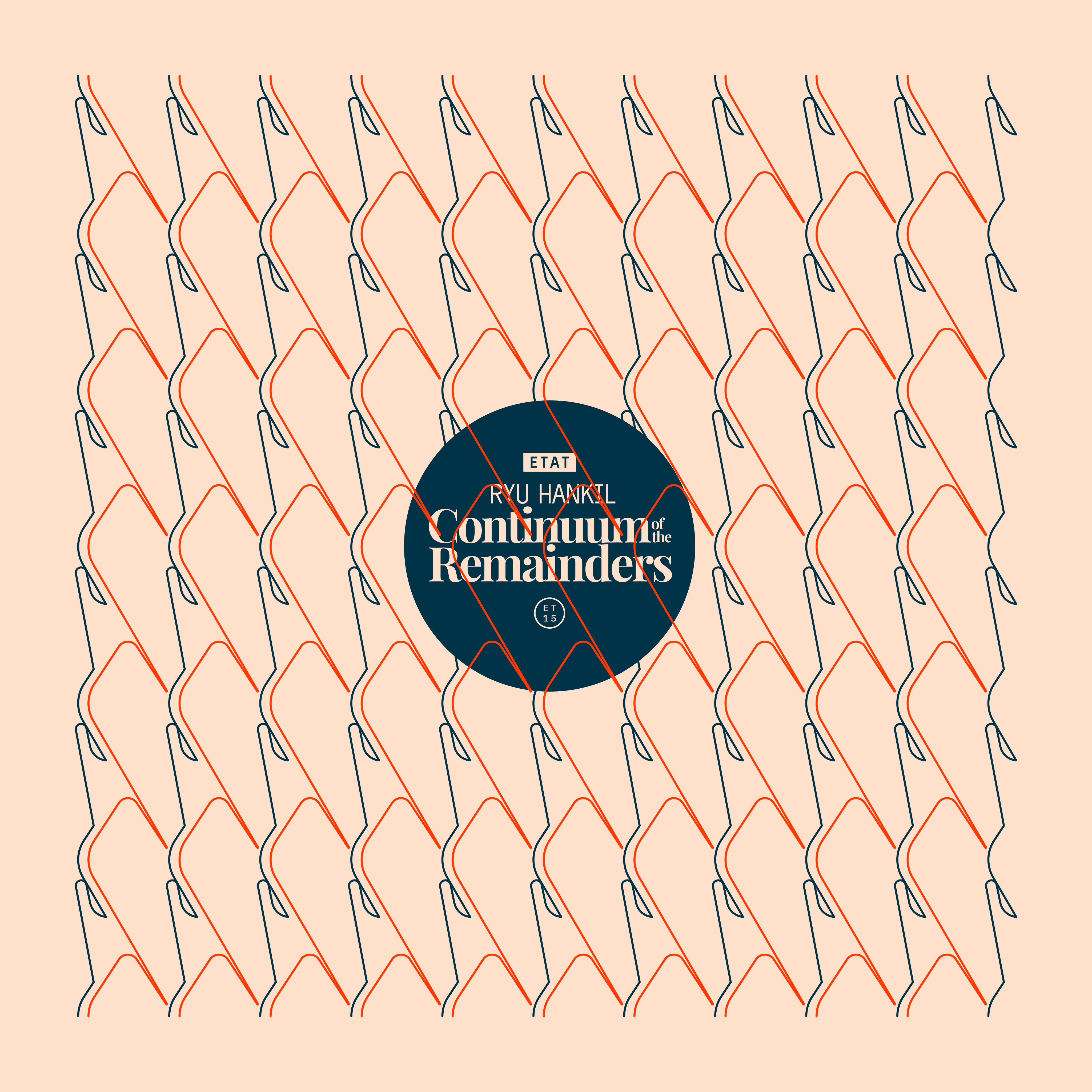
Ryu Hankil - Continuum of the Remainders
Pay attention, and it dissolves. Loosely pay attention, and the repetitive structures reveal themselves. Ryu Hankil keeps things very abstract with the Continuum of the Remainders. What you perceive is not necessarily what is going on. If this sounds difficult to process, that is the intention. ETAT has never been one to keep things easy for the listener. Usually, if you’ve somehow stumbled upon ETAT, you have already gone way further out in the audio spectrum than most human beings. Realizing this, it is perhaps unsurprising that ETAT allows free downloads not just of the music but of any philosophical/theoretical texts that might accompany such wretched, tortured noises. Fortunately, Ryu Hankil went above and beyond, producing a text that illuminates things not one single bit. Plus, the text is translated into English, with a Korean variant reflecting his background. So, you can get it free here, but fair warning, it is uneasy listening.
What are the approximations of what you might encounter? Those familiar with RM Francis and Hecker will, at the very least, have a reference point of sorts to help with navigation. Aspects of the sound are much more into the sheer shuttering of things. It highlights the sheer creativity Ryu Hankil expresses through his work. No normal person could have thought up such sadistic sounds, nor should they. And, had Ryu Hankil not found some waveforms to torture into stuttering messes, it scares me to think what he’d do to your loved ones. For these are twisted, jagged edges, on the furthest edges of what would be considered polite listening materials.
I appreciate the disorientation. Really, these tracks could go on for any length, because there is no discernible beginning or end. Nothing is built up, at least not in a perceivable way, and nothing breaks down. Yet somehow things happen. Almost trance-inducing in the sheer amount of movement that goes nowhere, Ryu is the Seinfeld of difficult listening. Parts of it do possess a particular strange sense of humor, and the text provided by Ryu Hankil reflects that. The glitch elements harken back to Ryu’s early days of the early aughts with his alias Daytripper, which was a more straightforward affair, at least within some discernible genre classification.
The number of electro-pop artists from the early aughts who went deep, deep into the conceptualization of sound and acoustics fascinates me. You have Jasmine Guffond, who had a surprisingly similar life trajectory; Madalyn Merkey, whose work started more on the hypnagogic pop side before ending up in its current location; and Ryu’s approach. I find it interesting that the relatively normal-ish tactics eventually broke down into pure abstraction. Going way back, I am reminded of Karlheinz Stockhausen, who had, allegedly, a perfect ear and could replicate anything he heard flawlessly, yet he didn’t want to. He wanted people to confront the difficult, to make things more challenging for the listener. Karlheinz saw the death of almost everyone in his family to a martial beat, and he devoted himself to the concept of an anti-rhythm, of breaking the rigidity that ruined virtually his entire childhood. There is plenty of easy listening available to people, literally tens of thousands of artists playing bank teller-core music. Still, difficult listening is probably more important and relevant to any attempt at growth.
So we are left with this, this mass of unintelligible noises that do not fit any rhythmic, melodic, or linear progression. The Continuum of the Remainder is difficult listening for people bored with hearing the same handful of chord progressions repeatedly, who want something that approaches sonic psychosis.
La Seconda Genesi - Tutto Deve Finire
The 1970s Italian Progressive Rock accurately captures the sheer levels of madness that Italy was experiencing at the time. Things were nuts. Politicians kidnapped and murdered. Far-left and far-right groups were engaged in conflict. Nothing made sense. Aldo Moro was found in the trunk of a car, dead, a prominent member of the Christian Democracy party. So the music reflected this – at times feeling like the hangover from 60s psychedelic, at other moments going for a more traditional bent. Many pieces from this era feature unusual instrumentation and almost Byzantine-like arrangements that can be easily lost within.
La Seconda Genesi’s one and only Tutto Deve Finire reflects this madness. Released on the extremely short-lived Picci label, which operated from 1971 to 1975 with limited runs (always a few hundred copies), the album seemed destined to fetch exorbitant sums. Vinyl of the 200-plus original run of the album will set you back anywhere between $3,000 - $7,000. So, if you have a copy, congratulations, you can buy a used car. Given the sound itself, I imagine lots of this would lend itself well to some particularly adventurous samplers, if they were able to get their hands on it. Even represses of the vinyl are not heavily circulated, and there are no official releases of a CD version, just some very sketchy (even by my standards) bootlegs.
An ebb and flow of the energy levels here works wonders. They excel in longer-form works, especially the centerpiece, Dimmi Padre. They sing exclusively in Italian, part of the reasoning behind the small initial press of the vinyl. Alberto Rocchetti is a skilled keyboard player and singer, and is the easiest member of the group to get information on. He has an Italian Wikipedia page with a background in pop/hard rock, and beyond that, I don’t speak Italian. It appears that his brother, Santino Rocchetti, had a more prolific career after relocating to Germany.
For me, though, the real highlight comes from the guitarist Paride De Carli. The only other band he belonged to was the similarly obscure Paride E Gli Stereo, which coincidentally released only one album that goes for a pretty penny (though nowhere near the thousands of dollars). Paride appears to really tie the group together, and he displays great range, going from electronic to acoustic at times, making it feel effortless.
Moments within the album are also fleetingly sweet at times, almost tender, and full of the sort of bombast you’d expect from early 70s progressive rock. They make sure to go a bit above and beyond the call of duty, and some tracks go bonkers. Arrangement-wise, they do a fantastic job shoving so much into only a little more than half an hour’s worth of music.
Fascinatingly strange at times, and impressively unpredictable in certain moments, this is a rare record where I understand the price tag. Outside of the rarity itself, the music is well-done, with some inspired moments that would be even more impressive with a truly devoted crate-digger.
Questions, Comments, and Concerns:
Please email me at beachsloth32@gmail.com
Want to support me financially?
Please PayPal me at beachsloth32@gmail.com
Throne
Throne | Beach Sloth | My Wishlist
**Your idea of a reasonable person, music-wise, I’m sure, differs from mine. **Still, if you’re already here, you’re already unreasonable by sheer virtue of your attendance, and I thank you for that. **
Last.fm