
01.25.2026

Good Morning,
This is Beach Sloth. Below are this week’s albums:
· Editor’s Note – Moving forward, anything that is abnormally loud and noisy beyond what a ‘reasonable person**’ would subject themselves to will be prefaced with a *Volume Warning*. Thank you.
*Volume Warning*
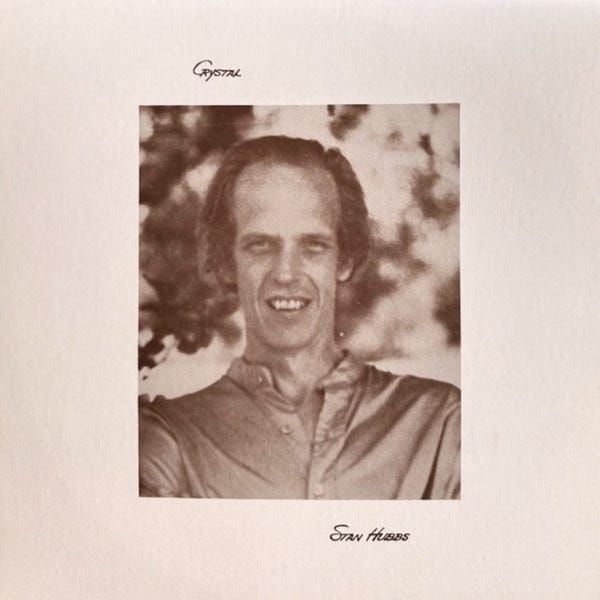
Stan Hubbs – Crystal
Legend has it that Stan Hubbs was the first and only human being to die of a marijuana overdose, and, listening to Crystal, it is easy to see why. Heavy is the head that wears the bong, and honestly, Stan’s head looks structurally sound enough to do so. I cannot believe that some of the absolute wildest dollops of insane psyche-fracturing psychedelic rock came out in the early 80s (see Chrome’s Half Machine Lip Moves and whatever you want to categorize Butthole Surfers’ Psychic Powerless, released in the good year of Orwell 1984) as prime examples. Among them, Stan Hubbs holds its own amongst the completely zonked-out tunes. You get chanted ritualistic singing, keyboards that riff endlessly, and drums getting sloppy toppy.
Do the lyrics make sense? No, but there is a lovely 16-page booklet made by Stan Hubbs. I guess to really make it in the psychedelic rock side of things, you had to go utterly and almost indescribably bizarre. As a young Hunter S. Thompson once said, “When the going gets weird, the weird turn pro.” Guess that saying works well in the musical side of things. Some of the more sprawling outsides of things, especially the spread-out vibes of Juggernaut, express what a shame it was to have only a single album released by this madcap. Rhythms never tighten up; they never need to. I rather enjoy Ron Castro’s expressive playing in anchoring the meandering melodies. Given that this is a relatively small group, they manage to have an outsized presence with the tracks. While I do wish they had created more 7-minute-plus jams, I understand this was their first and only album, so we are lucky to even have this limited thing to behold.
All the players involved, I imagine, sobered up at some point, excluding the titular Stan Hubbs. They went on to have those normal lives that Steely Dan sang about on “Kid Charlemagne.” I imagine one or two of the band members here had to drive quickly to escape some variant of law enforcement. For them, that line, “Is there gas in the car?” must have hit especially hard. Fidelity is an afterthought, as much of the album sounds as if it were lifted from a series of basement recordings on an 8-track. Even where this came out, from Northern California Camp Meeker specifically, continues to be a reliable bastion of outsiders’ last stand, north of Vallejo in a part of California that is not too northern as to be conservative and not too southern as to be unaffordable, that sweet spot, geographically speaking.
Rarely do I end these things off with a warning, but here I will – if you are caught listening to this in your place of work, expect random drug testing in your future. I say this as someone who has foolishly shared their musical interests with coworkers, only to find myself peeing in a cup. Nope, I am a sober-minded individual, just a strange feller overall who enjoys the furthest reaches of whatever sound has to offer. One of my old friends pegged me as “an obscurest,” and I cannot think of a better embodiment of that than this album. Pressed in a limited run of 100 copies from the powerhouse that was Golden Rose Records, last sold on Discogs thirteen years ago for almost a grand, the good folks at Numero Group have deemed this rarity worthy enough for a repress, finally reaching the masses, or at least anybody interested, for a price less than that of a monthly mortgage payment.

Zbigniew Karkowski - Untitled (For Guy Marc)
Zbigniew Karkowski was a rare breed of noise musician. Globe-trotting, endlessly strange, straddling the space between DIY noise and academia, he proved that noise can, in fact, be properly composed. The albums he released during his lifetime were scant by noise standards, which usually rely on a release every other week for eternity. Just look at Merzbow and how many albums he’s released over his entire career – too many to count. Interviews even ask Merzbow, “Do you know how much you’ve released?” and he’s like, “Nope.” I appreciate that level of dedication, especially to a craft where the audience size is always going to be small. When noise makes it into the mainstream, with Merzbow performing at Coachella, I’ll either be very long dead, most likely, or things will have gotten very strange, very quickly.
Untitled (For Guy Marc) is an album discovered after Zbigniew Karkowski’s death in 2014. Guy Marc was strolling through his computer files in Brussels, Belgium, no doubt eating Belgian waffles and chocolate, when he found this. Amazed, he gave it over to the good folks at Sub Rosa to release as a file. Zbigniew, or “Big Z” as he was known to his friends, would, on occasion, crash at Guy’s place. I guess that a hotel was out of the question. Into the question – crashing on some random Guy’s (literally!) sofa. Thanks to the power of timestamps, Guy was even able to put a date on exactly when this piece was composed – 2010, placing it around the Infallibilism / Bisskraft era. He draws on his training as a composer and translates it into the vocabulary of power electronics. Too delicate to be considered a harsh noise wall, it is rather subtle with the shifts. That’s not to say that this is by any stretch of the equation quiet – far from it. But it does benefit from his patience and from the attention to the low end. While the buzzing, harsh static is what you first notice, with extended listening, you can hear all those fine features he puts into the low end. I appreciate the way he paid attention to the drone/bass frequencies, as that’s usually the part of his sound design I appreciate most in his output. Like most of his work, too, there is almost no acknowledgement of anything existing outside – no bells, no whistles, no samples (which at least some noise musicians use to make it feel easier to approach). It is the most immersive of sonic territories.
I get why this is limited as an audio file, with no plans for a physical release. A release like this would have scant commercial appeal, and even during his life, he was obscure even within the noise community. Furthermore, there is something in keeping with the ritual of it existing as a digital piece – it was originally discovered as a discarded MP3 while a Guy was cleaning his PC. So, it feels respectful to keep up that approach, to make sure the legacy continues, albeit in a slightly larger form than something for one singular person to find several years after a death. The playful quality of Big Z comes from how silly he apparently was in person, joking with people, constantly traveling, living all over, and showing how noise composition can also possess a strange beauty, like how shoegaze reflects the chaotic din of amplifier worship and melody. While it may be harder to sniff out exactly the riffs within this piece, Big Z believes in you, as shown in the album art. Adorned by stuffed animals like some sort of wry Charlemagne Palestine piano ritual, he left the world far too soon, but fortunately, we are left with this sound to remember him by.

DJ Ramon Sucesso – Sexta dos Crias 2.0
If John Duncan’s shortwave experiments meshed with Paul De Marinis level of vocal studies, bound by favela funk, then you’d get DJ Ramon Sucesso’s Sexta dos Crias 2.0. What does any of that mean for you, the potential listener? Think loud, chaotic, extremely experimental, and, oddly, party-starting? Sexta dos Crias 2.0 continues in fine form after his initial debut album in 2023, which fetches considerable sums for an album released two years ago, but there we are. $50 to $80 is not bad for an album released two years ago, and repressing it is probably not the easiest thing for a boutique experimental record label based in Brazil. All those shout-outs, the toasts, the air horns, they are brought into this, with their context stripped away, making it the literal sounds of the party, and transformed into a party on its own merit. The equivalent of aural caffeine, this will wake your ass up.
Having this pressed on vinyl feels wrong in a way. The extremely digital/TikTok nature of the snippets, cut to milliseconds of their death, and the rhythmic way he cuts them up make it strange that they are captured for posterity. It almost feels fleeting, an improvisation from a digital point of view. Aspects even go for the slip-skip-jump of DJ Sniff, where it combines elements of the physical and the degraded radio signals of various channels. In some ways, too, I am reminded of Gert-Jan Prins’ explorations with pure electricity, though DJ Ramon is a far kinder sport than that prickly, free-jazz oriented Dutchman. So while it is a bit odd that this would be in a physical format, I am glad it is captured to offer a glimpse of what happens when the avant-garde hijacks TikTok, or vice versa. It proves to me that there are definite benefits to having such a platform, and this dude is from Brazil; all the language is in Portuguese, yet I’m still hearing about him, and lots of other people are as well.
A slightly longer excursion than his first album, there are perhaps more minimal edits than the first one. This does not feel as supersaturated. He does highlight the cut-up techniques used across different pitches of voice (not vocals, because people aren’t always singing). His ability to include low-end bass through these cut-ups is doubly refreshing, and while he did this on his debut, here it feels perhaps more indebted to glitch than before, with sharper edges. In some ways, it is almost a tad more experimental than before, with the usage of the toasts throughout making it seem like it is starting a party, as well as the ghostly remains of previous celebrations, the middle parts sanded off. So you get the excitement of the party and only the excitement of the party. The slow jams are clearly not welcome to this outing, nor should they be.
Lugar Alto released this one, as well as the original album. Honest Jon’s appears to help with the wider distribution, pointing out how unexpectedly popular DJ Ramon was the first go around. Is this for everyone? He requires a lot of energy from the listener, but that’s not a bad thing. Sometimes it is necessary to challenge the listener, and DJ Ramon Successo does that by pushing things just a little bit further on his sophomore Sexta dos Crias 2.0.
*Volume Warning*
Erik Dahl – Anti-Instrumentations
Every music geek has a handful of “white whales of music” they try to get their hands on, for whatever reason. Perhaps they are a completist; perhaps it is simply the fact that it remains so impossible to pin down. For me, Erik Dahl’s Anti-Instrumentations proved one of those recordings. You cannot find any samples of the music (if you want to call it that) online, which is highly unusual. Even the most obscure stuff I listen to, I can point people to something, anything, to at least give it a sample listen. No YouTube clips exist because it was a one-off release decades ago, and the sound is hard to classify. Also, Comatose Recordings is an anti-upload label, which I respect, and I guess everyone respects that, too. Electroacoustic, avant-garde, noise, and ambient would work to a degree, but even they fail to capture the full-on, unusual nature of the sounds. To get it, you must get the physical vinyl, since it was pressed only once and there are no plans to ever reprint it. Also, his name is bland (not a bad thing, just pointing it out), so you are likely to get some random Swedish pianist rather than finding him directly.
The inaugural release on Terre Thaemlitz’s Comatose Recordings Label, back when Terre lived in New York City, so around the Tranquilizer/Soil era, this is a difficult, strange release. Rhythm, melody, or any discernible element is not present during the recording. Given this release is about thirty years old, and years before Florian Hecker would explore something quite similar in tone, it is amazing what Dahl did with the limited computational power of 90s-era PCs, which were not known for their strength and power. It was not a Gateway, though, a computer that, if challenged to make sounds like this, would have probably decided to kill itself.
One of the originators of Web 1.0, Dahl refers to Terre as someone “just getting into electronic music composition,” indicating the pedigree and the time span during which Dahl worked with Terre. They met at Cornell Medical College, and I figured they liked each other enough to decide to work together. Before this, Dahl worked on the very early traces of avant-garde music, and the fact that he studied under Charles Dodge (yes, that one) indicates that he had a great deal of enthusiasm for sound design. There are very few traces of anything recognizable here – even the synthesizer tones are hard to place, with no clear origin outside of heavy computer music. Florian Hecker created similar sounds, but that was almost 5 to 10 years after this with IT ISO161975 and his magnum opus, Sun Pandämonium.
Reading his old website (a personal website, I appreciate the novelty), he has a genuine passion for the work he did. Everything he writes about, he does with such joy. I honestly get the sense of a compassionate person who loved life, and lived in one of my personal favorite states, Maryland, a state so lovely that America almost does not deserve it. There he raised a family, had baby pictures of his child, and overall did that sweet, early-era Internet stuff before it became all rage-bait and blood-pressure-raising. I see traces of what would inspire Terre’s own Comatose Recordings website, all that personality shining through. I cannot recommend checking out that Comatose Recordings site enough, as it has a classic, almost timeless feel throughout. You even get to see some of the earliest MP3 samples on there, though, curiously, not this one (the cut-off seems to be around 1997, years after this one).
This is difficult, ultra-experimental listening, wild kinds of stuff, hearing various noises pinging through the digital morass. Since this recording, he appears to have rebirthed multiple times, going from Web 1.0 to Web 2.0 to Web 3.0, and whatever happens next. He now works for Facebook, so he’s come a long way from working with Terre on Comatose (and Terre has since relocated to Japan). I am a tad saddened that Dahl, given his clear talent for exploring the abstract and his studies with Charles Dodge, put out almost nothing after this. Given his expertise with digital systems, especially the ancient variety, and since he’s still out there, he’s probably good with the newer stuff too. I would be curious about what that might have sounded like. Perhaps he’s doing some low-key Charles Ives shit, working a day job and gradually composing on his own, by himself. I hope that is the case, but no matter what, there’s something enthralling about this, a bridge between the early stuff of avant-garde composition and the more strictly digital stuff that followed about a decade later.
Questions, Comments, and Concerns:
Please email me at beachsloth32@gmail.com
Want to support me financially?
Please PayPal me at beachsloth32@gmail.com
Throne
Throne | Beach Sloth | My Wishlist
**Your idea of a reasonable person, music-wise, I’m sure, differs from mine. **Still, if you’re already here, you’re already unreasonable by sheer virtue of your attendance, and I thank you for that. **
Last.fm
I miss Big Z, he was always bringing something interesting to the table…