
02.04.2024

Good morning,
This is Beach Sloth. Below are this week’s albums:
· Editor’s Note – Moving forward, anything that is abnormally loud and noisy beyond what a ‘reasonable person**’ would subject themselves to will be prefaced with a *Volume Warning* Thank you.
*Volume Warning*
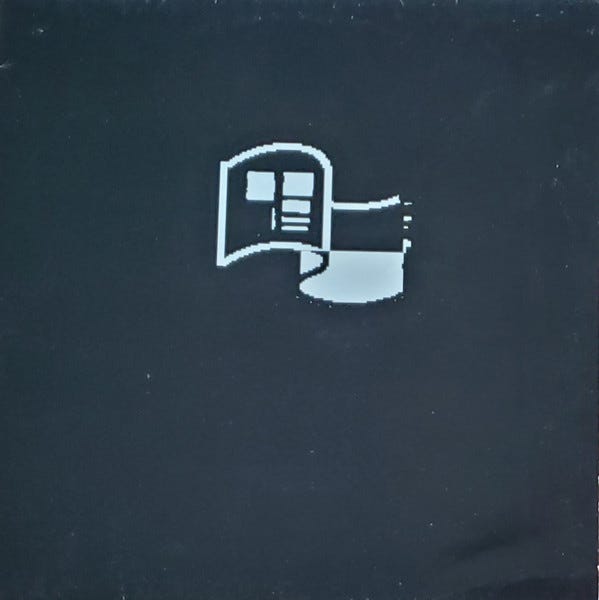
DAT Politics – Tracto Flirt
One of my most formative musical experiences was listening to DAT Politics’ debut, Tracto Flirt. There I was, in my living room, searching for new music. Already, my tastes were moving at a breakneck pace. I had started to get into the rhythm of stranger musicians, having hopscotched across many genres early on, trying to avoid anything I considered too limiting or lacking in creativity. Out of nowhere, I saw this weird group of individuals who played ancient dying computers for the whole world to witness. My curiosity was piqued, and I decided to listen to a song that would forever change me and how I listened to music. Conveniently, it didn’t have a name. None of the album tracks had names outside of the duration time and track number.
It was track three, harsh electronic feedback with a madness that would make Raymond Scott blush. It changed everything.
A good way of describing the entire album would be if Sesame Street approached Merzbow and asked him to provide music for the show. The loudness, ear-piercing feedback, and heavy distortion all fit into Merzbow’s modus operandi, barring one essential element: the cute music. DAT Politics plays it very cutely, and it shows. Melodies are naïve as if it was the baby’s first attempt at composition. Yet this belies a far more sophisticated approach. Underneath the twee scree, much thought is put into the arrangements. Think of their sound as a music variant of the CoBrA art movement. Like that movement, DAT Politics, especially on Tracto Flirt, seems to emphasize a child-like sense of boundless creativity, and the songs do not fit easily into any genre. You could easily see that children might have influenced this. Music is highly colorful, however, and the songs enjoy being on the much messier side. It could be noise, it could be pop, it depends mainly on the listener’s perspective and frame of mind.
They have all their bases covered – from the high shrill pitch to the rumbling bass lines, even with compact, boxy, square-wave beats. It is a joyous, shockingly emotional album from beginning to end. This is an accessible album despite the extreme frequencies they utilize in their endeavors; it is loud and noisy, and even noise fans might find it hard going. I say this because I’ve played this album for those exact types of people, and they called it “too extreme,” choosing to live a safer life. That’s their loss, and I want it to be your gain.
DAT Politics is a French group from Northern France, better known as the sad part of France. The French Riveria is south. Many college friends formed DAT Politics to brighten this not-sunny part of the country. Initially, three group members started with the post-rock outfit Tone Rec, and DAT Politics differs significantly from that considerably more formal approach. There are no rules here, and the sound is the most fun a sound can have in its electronic form. Nothing feels brutal; the songs, for all their harshness, have a lightness, downright giddy at times with excitement. Vocals are processed beyond any comprehensible recognition, transformed into squeaking mice chatter in cartoonish ways. It feels liberating to hear a mix of harsh noise alongside genuinely twee melodies and to be a neat balance of the two without either gaining the upper hand. It is this tension that guides the works along. Notably, France’s total fertility rate jumped significantly following this album’s release from 1.791 children to 1.874 children. Did the DAT Politics debut album contribute to this giant leap? I’d argue yes, it did.
Tracto Flirt was initially released on DAT Politics’ label Ski-pp as its inaugural release in 1999. A year later, it was re-issued on the considerably more significant (but still small) San Diego-based label Tigerbeat6, with two additional songs added. I heard it from this Tigerbeat6 release, as the Ski-pp release was limited. Even now, the influence this band has had over me continues – they are one of two bands I’ve bought a t-shirt from (guess the other band, you’ll probably not get it, I may reveal it, I may not) and cemented my belief that musical experimentation can be a happy, enjoyable thing rather than something brooding. I highly recommend this to anybody interested in what a noise group sounds like when they go cute. Maybe more should.
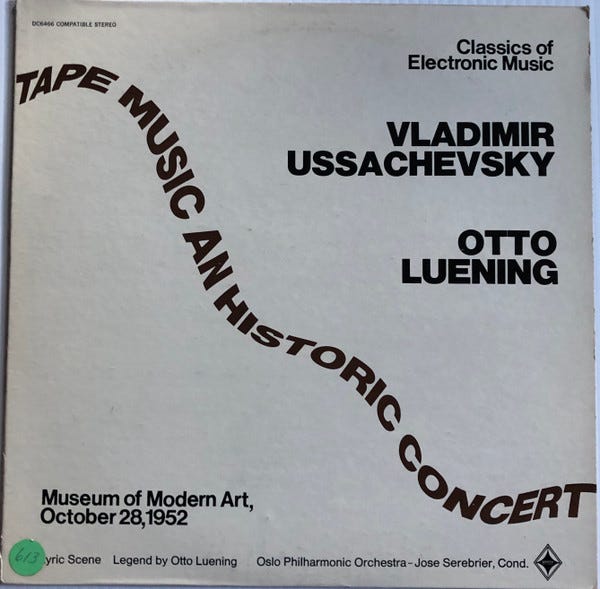
Vladimir Ussachevsky & Otto Luening – Tape Music – A Historic Concert
The title may seem a bit much, but it is genuinely justified. This is the first Tape Music Concert. While Halim El-Dabh’s “Wire Recorder Piece” from 1944 is the first tape music technically, this is the first time that an entire concert was devoted to the concept, all the way back in 1952. They Performed live at the MoMA (Museum of Modern Art in New York City for those in the know, and if you’re reading this, you probably already knew that); this is an exciting mixture of perspectives. Just as alien-sounding now as it was over eighty years ago, it is also worth noting that this concert, recorded in the 50s, would not be pressed and sold as an album until over a decade later, in 1968. The experimentation, even for the most strong-stomached enthusiasts, was a bit much, and the two were far ahead of their time. A
Vladimir Ussachevsky’s contributions are the far more envelope-pushing of the two. Vladimir was born in China to an Imperial Russian Army Officer in 1911. Eventually, Vladimir relocated to the United States for various reasons at the young age of 19. Russia, whatever happened there, especially in the early decades of the 20th century? His earlier works display a romantic quality, and even though they are more conventional, they display a desire to push the envelope. Later, with his more experimental phase (which this is a critical part of), he maintained a degree of that earlier romanticism, which can also be heard in all his output. A few of these pieces are genuine classics, including “Fantasy in Space.” Though one of the shortest pieces, the way he manipulates the flute on the tape is admirable, especially given how new the technique was at the time. Even now, it holds up quite well, a neat mixture of boundary-pushing while retaining a distinctive charm.
Otto Luening’s work goes for a much more subtle performance. An American original from the heartland (Milwaukee), he lived a long life and worked on many collaborations, far too many to list fully here. His take is less immediately experimental, though still beautiful. The ticks and changes within the compositions require more profound listening, and the approach is generally more traditional. This is not to knock Otto’s work at all; his pieces tend to be longer, and he was the ‘closer’ of the concert, so perhaps his idea was to bring the audience back from the edge of Vladimir’s more aggressive, chaotic, and avant-garde approach. He goes for longer durations within his pieces, and the changes feel almost invisible. Yet they are there, resulting in something that is ultimately quite moving.
The two met and founded an absolute monolith of avant-garde composition. Working together must have been a joy; they play off each other’s strengths well. Best of all, though everyone may not know these two names, they almost single-handedly trained the next generation of boundary-pushing musicians among their students, including one rapscallion, Charles Wuorinen. Unlike his teacher Vladimir, Charles Wuorinen was outspoken enough to talk his way OUT OF a tenured professorship, a feat deemed almost impossible in the modern era. A better, kinder student, one far better known outside of the avant-garde circles, is the Clockwork Orange soundtrack master, Wendy Carlos.
With this recording, which had to wait years for the rest of the world to catch up to the vision, an early glimpse of tape music’s potential can be seen, and the music feels just as lovely now as it did then.
*Volume Warning*
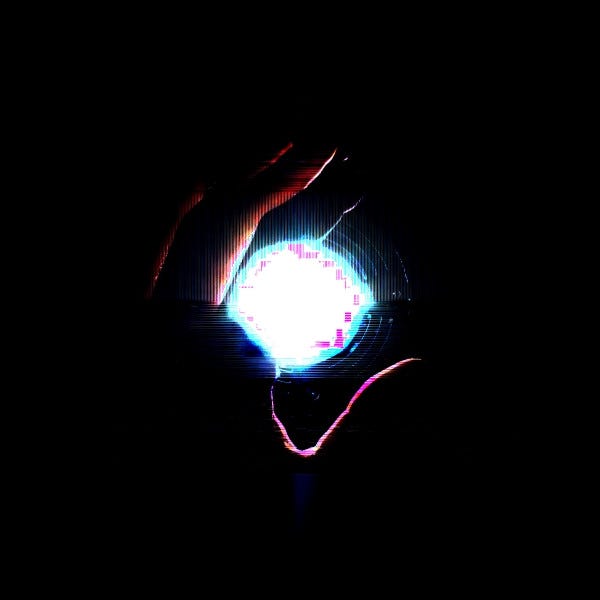
Five Star Hotel – Gray Data
Pittsburgh is America’s noise capital. Full of noise bands as far as the urban blight can allow, it is a low-key, genuinely decent, and criminally underrated city in the Rust Belt of America. Everything about it is precisely how the rebirth of a post-industrial town ought to be – trash-laden, cheap, and with an overwhelmingly active arts scene. Andy Warhol was the original creator of the art scene in Pittsburgh. From there, there’s a lot to process, and Five Star Hotel presents a stunningly crunchy take on noise, breakcore, and rhythmic noise.
Melanie Jerome is the brains behind Five Star Hotel, is a solo act. Please distinguish it from the Greek Brit-pop group that released one album in 2010. I am sure they are fine people, but noise versus Brit-pop, I know what I’m picking. Beyond work in music, Melanie is responsible for the Visual Disturbances label, which is currently in a dormant state. That’s a sincere pity because the work under Five Star Hotel is so astronomically good. I love the production values. The beats are crunchy, like chewing on potato chips, and a profoundly satisfying physicality exists within the wall-of-sound approach. Breakcore is not known for its adherence to high fidelity, but this is mastered so perfectly that I feel the need to point it out. Honestly, I hope Melanie has become a specialist in mastering music because, as an audiophile, it is pure pleasure to listen to. This might be one of the finest breakcore rhythmic noise albums in terms of the sheer quality of the sound.
Fidelity is only one part of the joy. Gray Data, besides sounding fantastic, has incredibly well-executed ideas. The sound is hysterical, almost slapstick. I appreciate the data-crunching that went into making this as flawlessly executed as it is. If someone wanted to do a pure noise rave-up done right, this is probably what I suggest putting on because it is that energetic and, honestly, quite playful. Volume is a must, but watch the volume with this one – a little goes a long way, as the frequencies used range from the ludicrous to the extreme. Melanie knows that the sounds used need to be tortured to an inch of their lives, and she does it with the most incredible amount of care, letting the work speak for itself.
For me, the best track on the album comes from “Courthouse.” Here, it is like a Vaporwave mixed with pure Harsh Noise Walls. It is funky, and it is ferocious. With that initial theme introduced, she teases out the sheer brutality of the methods, and it feels outright catchy. Perhaps that is the most significant takeaway from the entire album – the fact that, despite the extreme levels of volume used, there’s something inherently catchy about the whole affair, from the duration (clocking in at a little under forty minutes) to the sequencing between tracks. An absolute pleasure to listen to from beginning to end, and the better the sound system, the better the experience. The sheer fact that such a loud thing was pressed to vinyl gives me the most outstanding amount of respect for whoever was behind the mixing desk. Please, I strongly suggest checking this one out, for even for non-noise heads, it is simply so well done.
*Volume Warning*
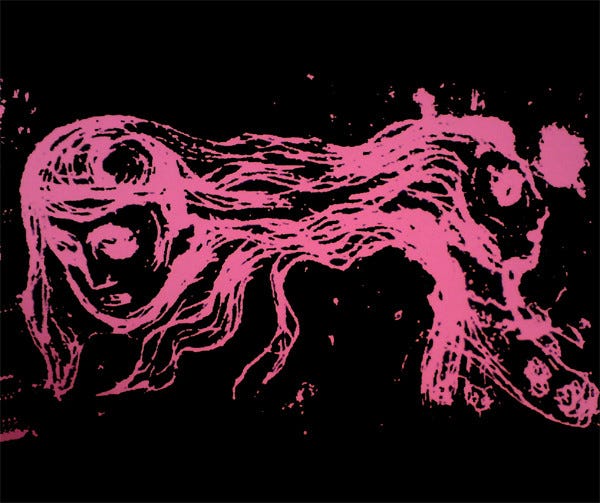
The Goslings – Grandeur of Hair
Florida has a weird streak. One can see this through their fondness for “Florida Man” headlines and the exploits that they partake in. Amongst the sunshine, there’s a definite darkness. It is no wonder that Florida remains the center of so much of America’s strangest, most destructive impulses. The old go there to die for a reason: the macabre nature is a great way to go. Long ago, people were put on ice and sent to sea with all their possessions intact. Funeral pyres and the like. Now, they want to be burned up by the sun and consumed by large, swamp-dwelling creatures. Of all the things Florida does, though, there is one thing they do well. Some of the most beautifully tortured music comes out of there – it houses plenty of metal, and while that is not my cup of tea in most cases, I get it. Metal tends to lack the visceral imagery I like, and for that, I go to noise. Amongst that noise is some seriously twisted stuff. The Goslings make the seriously twisted stuff with “Grandeur of Hair.”
It is impossible to process fully; a heaviness goes on about the entire album. Songs feel like they go on forever, and pay close attention to the immersive concept. Yet animalistic impulses and gorgeous melodies are hiding underneath all the noise. To call this lo-fi would be an understatement, as the sheer din they bring on is maddening. I enjoy what they do here as it combines so many genres in a way that I did not know could be so effortlessly well-balanced.
Tempos are slower than mud. With the droning aspect, they draw from Earth’s slow-motion car crash aesthetic. Fuzzed out beyond all clear recognition, they ensure you have no escape. Nor is this the latter-day Earth – this is the brutal origin story of Dylan Carlson’s fearsome beast, long before he got acclimated to a more mellow Ennio Morricone vibe later. Cymbals crash so hard they might as well be their variation on the guitar. That’s how incredibly intense the thing is. The drums are not much for time-keeping, as their purpose is on the emotional side rather than anything time-keeping. Time gets dilated through this sheer murk.
Which brings me to the next phase of the sound – slowcore. Yes, there’s a lot here that draws from the slowcore aesthetic. Far removed from the pretty side of slowcore, this is much more of the distorted side of Codeine’s sheer brutality and need to shock the listener. Going deeper into the slowcore aesthetic are the melodies. Melodies here have a haunting presence in the vocals and the guitar work. They make sure to keep it lumbering to match the tempo. Yet, for all the sheer din, the melodies have an almost classical take at times, gigantic and unnerving as they are.
Noise is everywhere. They don’t mind keeping it messy. By keeping it messy, there’s a genuine sense of mystery. Whatever volume you listen to it at, it always feels just beyond your perception, as if they are darting away from direct sunlight. It is quite moving, and the defiance alongside determination gives it a hallmark like Harry Pussy’s more No Wave-oriented output (and yes, they have those slow dirges that are deeply emotionally affecting, which is often, unfortunately, an overlooked aspect of their sound).
Heaviest is the incredible journey of “Overnight,” easily the album’s highlight. It is an absolute beast. The drums here feel like they are barely there, trudging through an unknowable amount of swamp-like ooze. With a low-end replicating an earthquake, this song has a seismic shift. Emotionally raw, it is the sound of being entirely and thoroughly spent. For all the gloom of the piece, it is possibly one of the loveliest, ugliest things you’ve ever heard. On this one, the whole purpose of the album feels unlocked: a Rosetta Stone, which deciphers the meaning of what came before and what follows.
A compelling document, the Goslings show off the force of nature with a sound as visceral as it is emotional.
*Volume Warning*
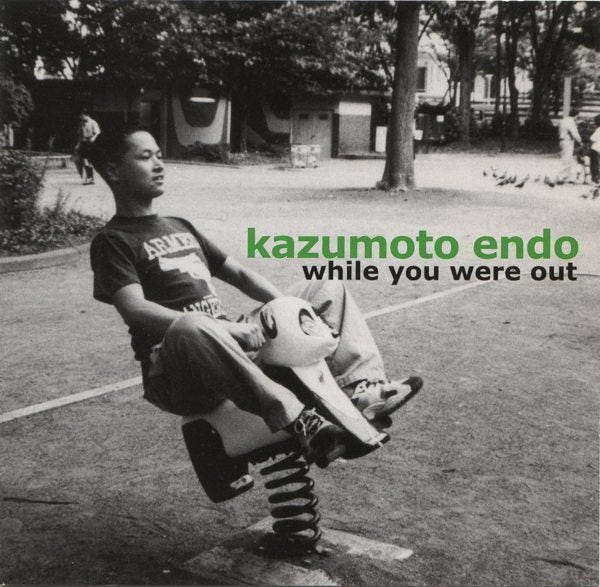
Kazumoto Endo – While You Were Out
A gleeful chaos emerges from the sheer giddiness of Kazumoto Endo’s While You Were Out. Before this came out, he had previously released work under the alias Killer Bug, an alias that appears to have run its course, with the last release a half-decade ago. With this release, even though several of the tracks appeared on random compilations, it does work together as a coherent statement. There’s a cohesion that comes mainly from the similarity of the themes of utter playfulness, and yes, this is a happy release despite the extremely noisy origins of the sound.
The cover tells the listener all they need to know. He has a childlike sense of wonder. In that playground, he proves that there is a desire to have fun. By not taking himself seriously, the way the song progresses feels unique. On some tracks, he seems to replicate the rhythm of that piece of playground equipment he’s seated upon, especially on the first track, opener, and absolute beauty While You Were Out. Within the piece, there’s a mixture of glitch effects, Max DSP crunching, and generally making as much of a mess as possible. Seeing him live is probably quite the experience, as he does not take himself seriously, and that attitude shines through the entirety of the collection.
Including samples on other tracks highlights this spirit, like on the goofily titled Fear My Kung-Fu. The spirit shown within the tracks often feels highly reminiscent of the sorely overlooked Hong Kong-based Xper.Xr also takes a similar approach to noise, allowing quiet fun into the equation to show a more accessible, silly side of noise. This is usually the path not taken by many noise musicians, who typically opt more for the ultra-nihilistic side of things, to their detriment much of the time. I felt it necessary to point this out because noise can be edgy for edginess’s sake, and the nihilism is a tad tiring. Sure, I get it; you’re pushing the envelope with those track titles and subject matter, but would it hurt you to smile every so often?
Kazumoto keeps this in mind, with the tracks working their distinctive wonders on the listener. The album clocks in at just under fifty minutes, and the songs tend to veer mainly on the shorter side, excluding the epically sized open. He also seems to bridge the gap between analog and digital, as you get both parts of the equation, allowing an unusual degree of variety.
It’s just a plain old fun release, surprisingly engaging and with an attitude of joy that is often lacking in noise.
*Volume Warning*

Umpio - Dub Electronix Vol. I
Pentti Dassum does a lot. With a musical resume going from folk to Elvis covers to Mr. Bungle-like freakouts to Black Dice excursions to pure unrequited noise, he seems to have been involved in every possible music scene within Finland. A multi-faceted, multi-instrumentalist, he sees no reason to limit himself to even existent instruments. With Umpio, his noise alias, he’s interested in creating his distinctive junk instruments. Besides his musical output, he also runs the Nekorekords label, on which this album was released. Upon listening to it, it does veer away from his typical fare of the brutal onslaught of noise that this alias is reserved for. This is to everyone’s benefit, as the result is shockingly groove-centric while maintaining the punishing hit that makes the project compelling.
He’s not alone in being the only Finn who combines industrial and dub. The Ilpo Väisänen (one-half of Pan Sonic) has a not-subtly named I-LP-O In Dub, an output of his more dub-influenced projects. Furthermore, the industrial/dub aesthetic even comes to the United States, to the group Pocahaunted in some of their better work. A noise/dub purpose also appears within Macronympha’s discography, specifically the uncreatively-titled “Dub Of Macronympha.” Macronympha is also a great point of reference, as they utilize the junk-noise aesthetic, making that the cornerstone of their sound, letting things go way too far. Fortunately for Macronympha, they live in Pittsburgh, where an excess amount of scrap metal exists, alongside a cheap cost of living that allows them to live as the purest form of noise artist.
The five pieces found on Umpio’s dub excursions are surprisingly catchy. Bass rumbles are genuinely massive in the best way. Jagged shards of noise are tastefully sculpted, serving as riffs. Delay effects found so frequently in the dub are skillfully used, virtually carving out aspects of tempo within the sheets of noise. It is a clever way of sculpting something discernible out of the abstract, helping to offer Umpio’s rather studious junk noise approach to a larger audience. Additionally, his knowledge of dubs is impressive but harkens back to his deep roots in a slew of different genres and forms of instrumentation. Sometimes, these tracks even get close to the massive sound system approach of noise and dub artists. He blends the two elegantly, and tracks like the opener “Ruukki By Night” alongside the epic closer “In De Getto” add to the sense of sheer physicality. Within the noise, elements of melody and riffs emerge, further adding to the relatively kaleidoscopic array of color. The sound embraces the psychedelic elements, again proving where noise’s roots come from, even more so than the industrial’s influence on the sound.
Umpio’s album is a slight detour from the noise project, retaining the sound while reframing it in a surprisingly groove-laden context.

Baba Stiltz – Total
Straight out of Sweden, Baba Stiltz has gone on quite the adventure through the American West. He began his musical leanings as a Deep House producer, and this is some of his earlier stuff. In fairness, the music is well-produced and sounds fine, but a hollowness prevents that deep emotional connection I typically look for in music. Yes, he varies the sound up quite a lot, but there’s a total lack of risk, a desire to play it safe that prohibits much of the album from landing with me. If you were to hear this in some waiting room or while boarding a plane, you’d barely blink; that’s how generic it feels. It is one thing to have well-produced music; that part is easy, but on the other hand, it ought to have some form of engagement with the listener, and the timidness on Baba’s part is readily apparent.
Out of all the tracks, perhaps the one that resonates the most is Golden Eye. Maybe this one goes into that trance-like state I enjoy hearing within Deep House. Also, I’ll admit it – the Golden Eye reference brings me back to the 90s playing that stupid game, so I must give him credit. Beyond that, there is little else. Maybe the only thing he tries to use to distinguish the music from the typical Deep House fare is the vocals, which are fine. Honestly, their lo-fi approach does allow some contrast between the polished gleam of the electronic sound versus the rawness of his voice. However, it does not feel like enough, and the word choice within the vocals, even by dance music standards, feels particularly meaningless. Mostly, they are window-dressing for what appears to be an absolute void of musical blandness, which never really touches the soul and isn’t very pleasant, as house music generally tends to work best with soulfulness.
Baba eventually took a dramatically different approach with his music, resulting in a musical left turn so unexpected that it stuns me that he kept the same alias for it, given how dramatically different it is from his Deep House fare. Indeed, later, he learned from this outing and decided to tour around the American West as some human tumbleweed, collecting stories and sharing them with the world. That’s all I will reveal as I plan on exploring his latter-day discography later. For this album, though, he was still trying to discover what he wanted to do, and it shows, as he plays it way too safe and takes essentially no risk whatsoever, resulting in a boring, monotonous album.
Questions, Comments, and Concerns:
Please email me at beachsloths@gmail.com
Want to support me financially?
Cash App (this allows me to buy food, headphones, and assorted clothes so I may dress appropriately in public):
$beachsloths
** Your idea of a reasonable person, music-wise, I am sure, differs from my idea. Still, if you’re already here, you’re already unreasonable by sheer virtue of your attendance, and I thank you for that!
Last.fm