
02.22.2026

Good Morning,
This is Beach Sloth. Below are this week’s albums:
· Editor’s Note – Moving forward, anything that is abnormally loud and noisy beyond what a ‘reasonable person**’ would subject themselves to will be prefaced with a *Volume Warning*. Thank you.
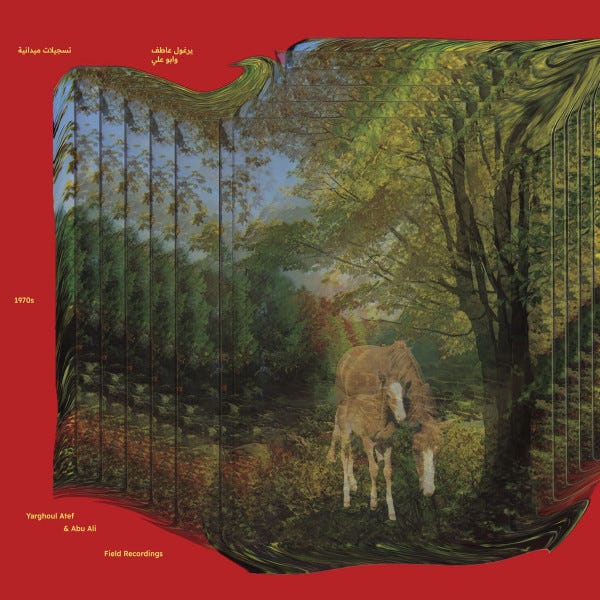
Atef Swaitat - Palestinian Bedouin Psychedelic Dabka Archive
Trance music, given the chance to trance in a decidedly ancient way, with Atef Swaitat’s Palestinian Bedouin Psychedelic Dabka Archive, takes decades to arrive at these eardrums. Well worth the wait. Besides, I’m a sloth; everything takes a long time for me, so I extended that outwards towards the very music I listen to. Recordings from the ‘70s, made up of two people (Atef Swaitat on yarghul and Abu Ali on lead vocals), they make the sound gigantic. Part of that can be due to the yarghul’s abilities – an ancient instrument, it contains all these intricacies. Add that to the overall lack of familiarity I have with the yarghul, how rarely I have heard it, and how distinctive it is, and I can see why this would be a trance-inducing sort of wedding. Honestly, if I ever had a wedding, this is exactly what I would want to play at the wedding, that and a bone-rattlingly loud pipe organ. So, really, if I ever have a wedding, know it will be a good weird time.
I will say they refer to this as a field recording, but as far as a ‘70s field recording goes, the fidelity is pretty good, given the circumstances and the length of time. The level of love shown to these elongated works is respectful, and the reason is surprisingly personal – Mo’min Swaitat is not only of Palestinian heritage, but grew up with this music around him, and notice the last name. Quite literally, it runs in the family, and it feels like a genuinely lovely thing to do for your father. Mo’min is a good son to have mastered this, and the fact that it can be accessible to those far outside the 1970s Palestinian wedding scene is, frankly, outstanding. Coming from a musical family myself, if I were to find something like this from my father or grandfather (cassettes of their recordings), I’d be doing my utmost damnedest to make sure that the music would reach anybody interested. So I appreciate this level of familial devotion, the continuation of the tradition, and the focus on a part of culture that most would be painfully unfamiliar with.
His understanding of his heritage works wonders, too. Mo’min is aware of the exotic stigma often associated with Arab music. So, by understanding the on-the-ground reality of the thing, he’s able to avoid the unnecessary and quite frankly overdone excesses that the genre gets unfairly painted with. Anytime an outsider tries to highlight this more political tenor, it also tends to be somewhat disconnected, even if ultimately well-intentioned. Muslimgauze, who devoted his whole life to highlighting the plight of the Palestinian people, to some degree was always a tad too removed from the reality, and, while heart was in the right place, it did also fall into some of the pratfalls of exoticism, though not of the Habibi type, the disco, funk type, but of something that still managed to other the music he sampled/created.
Mo’min understands too the fragility of the music and the culture. Many of these cassettes are still being digitized from the comfort of his London home. For those unfamiliar, cassettes are notoriously fickle things. I have shown so many individuals how to loop the cassette tape back into the tape, and that was with relatively young tapes compared to the decades-old ones he’s working with here. Ask many musicians who have worked with cassettes, and they will tell you the degradation of the sound is very real, and you do not always get the chance for multiple takes during transfers. Sometimes, if you don’t get it done right the first time, there’s no chance for a next time; the tape’s already ruined. I may be highlighting the worst-case scenario, but for something as personal as this, I can see why the Majazz Project releases are done so slowly. Besides, for a music-obsessed person, time is just a construct; it isn’t real. When you are dealing with music this psychedelic and trippy anyway, that concept of time melts away further.
A joyous experience of sound, the intersection of familial ties, geography, culture, politics, and tradition is remarkable. The atmosphere captures the perfect moment of celebration, and the duo’s freewheeling spirit feels outsized for just two people. This is life-affirming work, opposed to the concept of death, offering what the sound of rebirth can be.
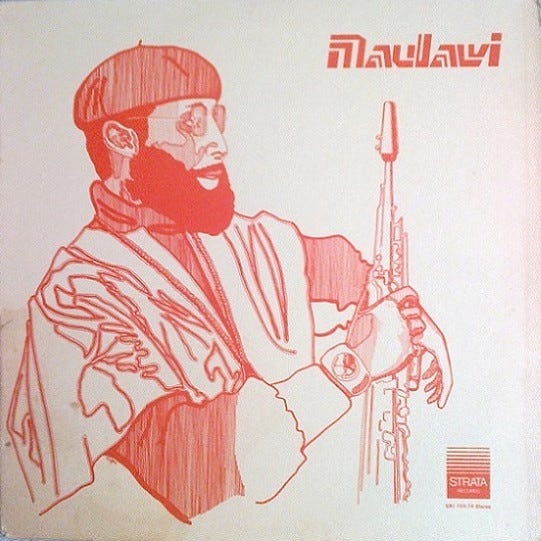
Maulawi – Maulawi
You may think to yourself, four drummers, that’s too many drummers. What I think is that more bands need this many, or even more. The sheer level of percussion love here is a thing of exquisite beauty, the rhythm after rhythm after rhythm. Everything syncs into place. Genres pour out of this thing, Mamba, Post Bop, Free Jazz, Soul, you have a litany here. Makes sense, then, that the person right at the center of this, Maulawi Nuruin, was a multi-instrumentalist. Whereas his birth name was Willis Wardel, he might have changed it to avoid confusion with the jazz musician Wardell Gray. Does it detract from the efforts here? Definitely not, the music speaks for itself in the loudest possible voice. Besides drums, Maulawi played saxophone, oboe (which never gets any love), and piano. Thus, you can hear in certain songs his percussionist tendencies manifesting in unexpected ways, such as when the saxophone temporarily transforms into a beat during the extended journey of Sphinx Rabbit.
Information on Maulawi is scant. There is a book about him, written by his granddaughter, that refers to him as ‘The Mysterious Jazz Player in the Basement.’ Even this tiny amount of available information only hints at the work he created. Within the short (under forty-minute) run time, he covers an insane amount of ground. On Street Rap, he takes a neighborhood conversation and twists it into funk. You get the emotional shifts that are equally stunning, at one moment friendly, the next yelling to take a dog away, looking for a drink, and it has this naturalness. Aspects recall Miles Davis’s On The Corner, as there’s that mix of informality with extremely tight grooves. It is a neat trick, and Maulawi, if anything, takes that kernel of an idea and lets it grow. So instead of the three-minute piece Miles came up with, Maulawi expands it and makes it much more abstract, akin to an imagined field journey from a neighborhood. Here, I get a tad sad, thinking about the neighborhoods I grew up in, all the noise that included, and hoping that places like this still exist, where you can talk to people as loudly as you want. I am a loud person, and living in a place as quiet as where I’m at feels almost out of character.
He’s good at the quieter moments, too. Root in 7/4 Plus leaves it mellow. All those percussive elements are so silky smooth, and his saxophone work flawlessly mingles in with Joyce Major’s vocalizations. Many of the players on the album are hard to pin down and hard to find elsewhere. One exception exists, and it is an important one – Rufus Reed. So many of the tracks benefit from his bass work, and much of the celebratory atmosphere comes from Maulawi, with Rufus lifting him up in the right places. You get this sense of community that flows through here, and Maulawi appears to have brought an entire community to play on this ultra-obscure, rare record, one of a handful released on Detroit’s Strata Records.
Strata Records albums go for quite a bit due to their rarity and quality. I am happy to report that this album checks both boxes. The music here is solid, emotional, joyous, some life-affirming stuff. Being part of a very small label from the early ‘70s, this album typically runs around the $1,000 price tag for the original LP. Fortunately, I am not the only one fascinated by Strata Records; another fellow crate digger, Amir Abdullah, plucked this and many other Strata records out of obscurity, reissuing them about forty years after their release. As someone who rarely leaves home except for hikes in the woods, work, and groceries, I appreciate the dedication. For a bonus, when Amir Abdullah found Kenny Cox’s widow (Kenny released two albums with Blue Note under Kenny Cox and the Contemporary Jazz Quintet), there were tapes and tapes of unreleased material from the ‘70s, which were released on Amir’s 180 Proof Records. So that way, individuals could finally experience the music. It’s also nice that Amir was able to provide the funds necessary to bring several of these albums to light for the first time in four decades, while also improving the accessibility of ultra-rarities like Maulawi’s work.
Is Maulawi still alive? Honestly, I tried searching for him, this mysterious person in the basement, whose granddaughter spoke admirably of, but he’s old and probably doesn’t deal with the internet because he’s smart. I wish I were that clever, but I do feel thankful that I was able to hear this self-titled debut, a fantastic blend of avant-garde tendencies with a soulful heart.
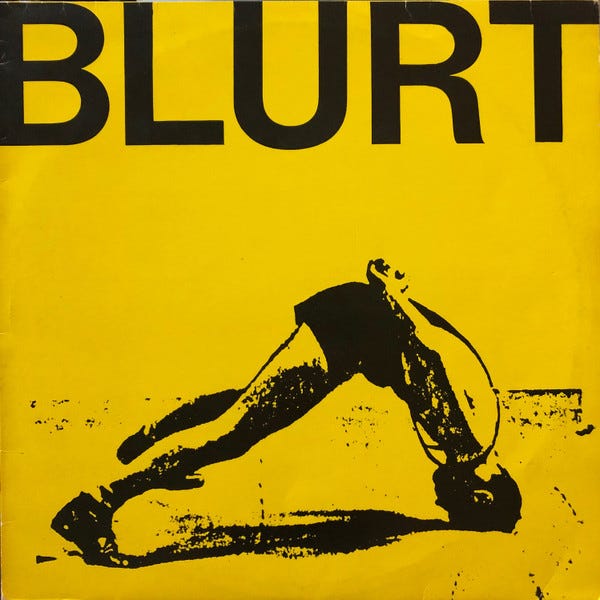
Blurt – Blurt
Play that funky music, no wave boy. Blurt plays that funk the only way that no wave can – with a level of jerkiness that may induce nausea, glee, and extreme anxiety. They take a note from across the Atlantic, specifically from James Chance and the Contortions. Whereas James Chance took a much more confrontational approach, the vocalist and saxophonist Ted Milton takes a tongue-in-cheek approach. Humor is frankly bizarre, even by British standards. Lyrics are cryptic, nonsensical things. If you can decipher meaning within it, all the more power to you, but I am also okay with it being utter nonsense; if anything, that’s a bonus to me. Besides, his yelping delivery is part of the groove, and the gesticulations that he draws upon bring up memories of some of Pere Ubu’s output, which was reaching its height right around the time of this release (in 1982).
Rhythms are insanely tight. The whole group is really aligned. I am reminded of one of my dearly beloved music teachers, who said that the two genres that had more in common than either would ever want to admit were noise and funk. A fine line exists between hyper-structured order and outright chaos, and Blurt balances between the two extremes quite well. For all the esoteric nature, there’s a very distinctive post-punk no wave ethos that makes the whole album a lot of fun. Nor do they overstay their welcome, clocking in at just a little under forty minutes. He’s a good saxophone player, too, and some of their other albums veer more into the free jazz side of things.
An acknowledgement to the guitars and, just as importantly, the drumming, is in order. The whole band really syncs up nicely. Interplay feels liberating. Word choice is random, which again is a form of liberation from meaning. Some of the rhythms have a jazz-like, even North African quality in a particular light. It also helps that, despite their experimental nature, they pare the sound down to the bare bones. You get to feel every single gesture, feel it right in your stupid bones. Sometimes, which is a very strange thing to admit, Blurt’s approach is reminiscent of what Vampire Weekend would explore decades later, though with the saxophone replaced by a keyboard and the downtrodden British origins traded up for some preppy kids from Cape Cod. Also, all the lyrics for Vampire Weekend make sense and mostly deal with lamenting the loss of various forms of punctuation, like the Oxford Comma, which is used in many lists, especially longer ones, to provide greater clarity.
James Chance’s work generally worked on a smaller scale than these. Here, Blurt betray their name, with most of these songs being extended cuts. Nothing blurted, besides perhaps the verses, none of which are logical. Several flirt with the seven-minute mark, and it is easy to see why; they enjoy the extended jammers. Others might find some similarities between this group and Can, and while I can kind of see it, it does not capture the clearly more jazz-influenced side of things, though the trippy aspects are certainly there with the seemingly endless drumming.
Fun, weird, and a sign that the late 70s and early 80s were an unusual time in music, this album is still quite easy to find at reasonable prices. I am genuinely shocked that this has not been sampled more because this is a blast, and the sheer number of great grooves they stumble upon is a thing of true beauty.
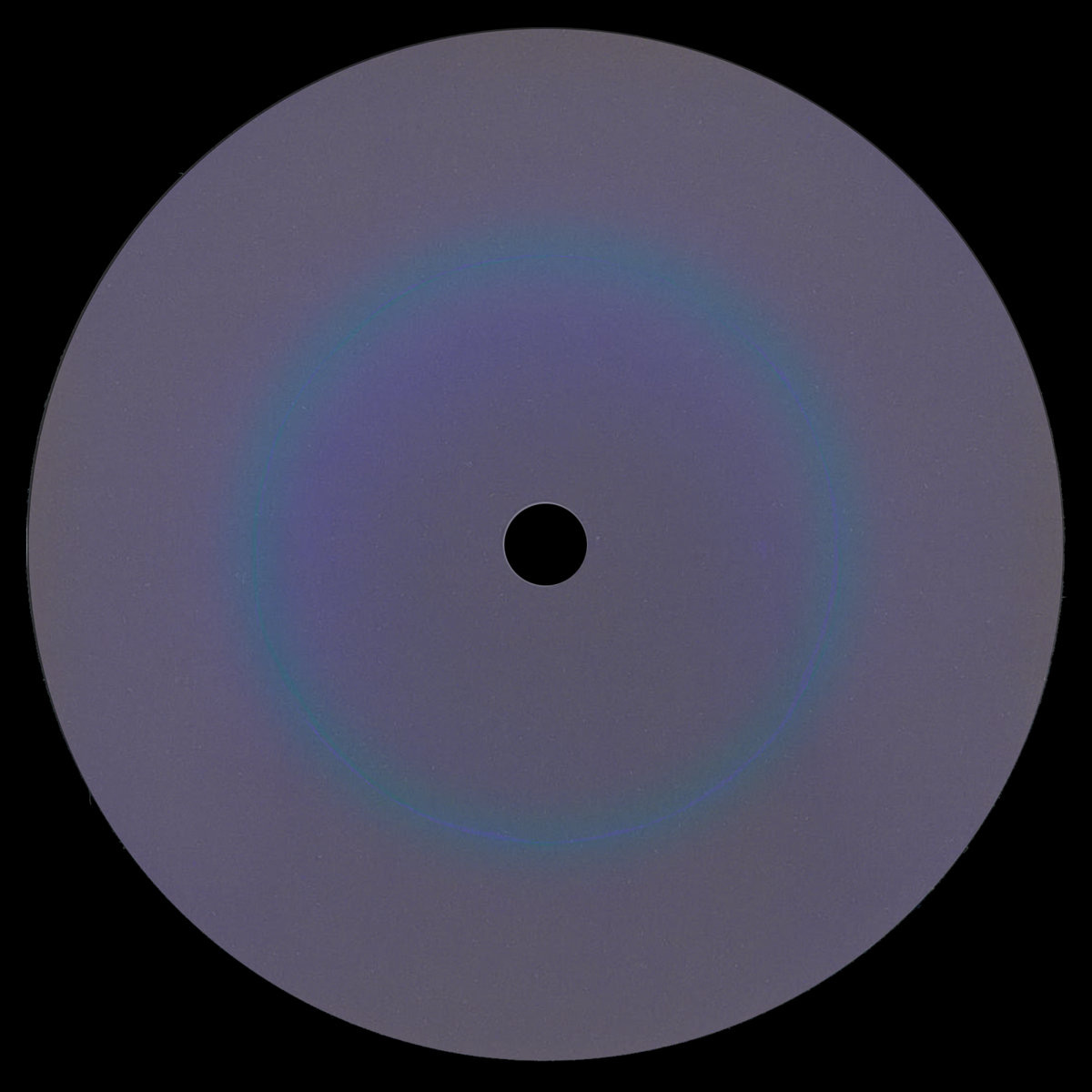
Ring – Rotation
Reject modernity, embrace tradition – Ring, when they went with Kino Disk for a lathe cut dubplate.
Lathe cuts are a rare breed, not made for mass consumption. In fairness, dub techno is also built in a similar way – for very specific consumption under specific circumstances. The dance elements are long gone. What you are left with is the mere traces of what had previously been there. Dub techno could be seen as a fossil record, the remnants of the original music, a ghostly presence. A nice thing about lathe cuts is that they make things personal, very personal. You basically get whatever hardship the poor audio technician had in trying to make the sound as pitch-perfect as possible. Sometimes this does not matter, such as when the sound was originally tinny. People still have this level of knowledge, but it is at best esoteric. Believe me when I say, if I call something esoteric, it is well off the beaten path. On a personal level, I have only one thing that could be considered a lathe cut, a 7’’ from Mohamed Karzo’s Mafelawen EP off the Sahel Sounds imprint, which trades in the genre of desert blues, so a niche thing. When you want that additional intimacy in the sound and know the audience won’t be huge, that’s ideal territory for a lathe cut.
Ring does the format tremendous justice. I love how Kino Disk keeps the knowledge alive, only a few miles away from me in Chicago, Illinois, one of America’s most underrated cities, despite its size. There is a very rich musical heritage that comes from Chicago and, in fact, much of the Midwest. Look at Detroit Techno, one of the origins of dub techno at large (the other being Berlin, Germany). Are both places full of abandoned, cheap spaces that lend themselves well to experimentation? I would certainly say so, as someone who has attended underground dance parties in car junkyards, one of my personal favorite memories, especially walking home so late at night it felt like I lived in a sleepy village instead of a hundred-thousand-person-plus subsection of Brooklyn. Maybe depopulation of major urban and rural centers has some plus sides, if it creates music as inherently lovely as this, elegies to music long since dead, capturing the ghosts on vinyl in real time.
Kino Disk does quality cuts of their work, usually running around the 7’’, 10’’, and rare 12’’ format lengths. The label consists of two single people, mastered by Jason Letkiewicz (mad Eastern European shit there, bet he knows where I could get some good homemade pierogi) and art by Micah Giraudeau (less convinced of this individual’s pierogi procurement, though I would like to be convinced otherwise). In terms of the actual sold, this is quite a thick brew too. They go for the psychedelic, hallucinogenic quality that dub techno brings. Other genres classify this as ambient, as there is no discernible beat. Whenever a beat does emerge, it feels like Ring stumbled upon it, almost a “oh sorry to bother you, I’ll just be heading on my way” not to be heard from for several minutes before getting lost again, going in circles because time is a flat circle.
Two sides exist. On the A Side, it has a steady pacing, with extended drones that feel luxurious. By far, for me, the real jewel is the B Side. Here Ring taps into what Jan Jelinek could have done if he had followed that loop-finding-jazz-records rabbit hole into a more Basic Channel sort of environment. You can almost hear the scrubbed-clean near-vocals of whatever existed before. It is a real show-stopper, and the mastering adds to the inherent sunniness of the composition. Echo makes the sound feel enormous, almost unknowable, as the various elements filter into consciousness. It is life-affirming, beautiful work that proves how sophisticated any genre can be when people devote themselves fully to it. Aspects go for this grandeur, and having the B Side extend longer than the A Side feels appropriate. Every single detail comes into full view, and it is downright gorgeous to behold.
Micah did good work on the album art for this – a Kino Disk stamp on some minimal packaging. The artwork is of a notary public deciding to turn that lovely little stamp of theirs into something more artistic. I have seen printing presses, with the iron keys and ink and everything, in the basements of unassuming ranches in Lincoln, Nebraska. I am given the same care, the same compassion, and a sense of love in this release, from the pining sweetness of the sounds to the handmade quality of the packaging itself. A gorgeous work to convert others to the inherent living nature of dub. As a nice bonus, the good folks at Kino Disk offer this as a Buy Digital Album Name Your Price, in case you blinked and missed getting a physical copy.
Questions, Comments, and Concerns:
Please email me at beachsloth32@gmail.com
Want to support me financially?
Please PayPal me at beachsloth32@gmail.com
Throne
Throne | Beach Sloth | My Wishlist
**Your idea of a reasonable person, music-wise, I’m sure, differs from mine. **Still, if you’re already here, you’re already unreasonable by sheer virtue of your attendance, and I thank you for that. **
Last.fm
Bitterly disappointed that Blurt isn't a new band. They sound current. I loved them.