
04.06.2025

Good Morning,
This is Beach Sloth. Below are this week’s albums:
· Editor’s Note – Moving forward, anything that is abnormally loud and noisy beyond what a ‘reasonable person**’ would subject themselves to will be prefaced with a *Volume Warning*. Thank you.
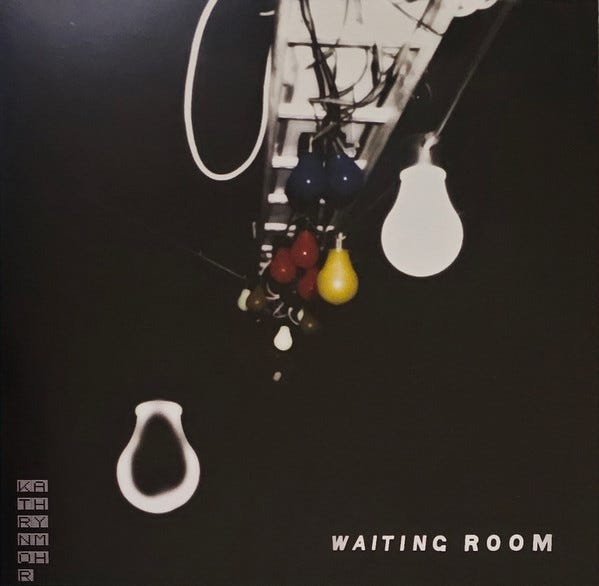
Kathryn Mohr – Waiting Room
Kathryn Mohr’s Waiting Room is the most skin-crawlingly creepy album of 2025. I mean that as the highest praise. So often, there’s noise that tries to be ‘edgy’ or ‘mysterious,’ but is usually some well-off guy screaming into a microphone with feedback included about how oppressive it's to be him, even though it probably isn’t. While I do appreciate that tact from time to time, it does get stale and predictable when people use an approach that came about before I was born (at least in this life, don’t get me started on my previous lives, in one of them, I was a Viking, another one, a No Wave musician which is elaborated upon below).
I love it when people take the opposite approach. Barely anything in Waiting Room is above a whisper, and it works. This is about as unsettling as it gets. Nothing here is comfortable, and the arrangements are so minimal they make Jessica Pratt’s output look like Joanna Newsom’s orchestral flourishes. Here, nothing moves quickly, hence the need for a waiting room component. Instead, she adopts a bluesy approach, but like the ghosts of the blues, she is ready to force you to acknowledge that you are living through some difficult times right now.
A handful of approaches come through. There is the bone-chilling eeriness of a singular acoustic guitar, making those works like Mike Hurley’s First Songs if they had contemplated suicide. Grouper’s drone-like vocals are another reference point, and the vocalizations extend far beyond recognizability. Instead, they melted away. Occasionally, wisps of the lyrics become clear and come into focus. When they do, they are equally unpleasant as ghostly, backwards-coded verses. On the rare occasion that she emerges from the near-silent nightmare, it sounds like grunge rock, but it had suffered a concussion and is trying to hold it together.
Electronics, combined with the folk, add to the inherent unease. She makes both work their magic, drawing the listener further into her pitch-black aural universe. The electronic effects are simple yet highly tasteful. Often, they are used so sparingly that you barely notice them, as a sense of unease lurks right underneath the surface. Some of the melodies she incorporates have more in common with Jandek’s version of the blues than anything else, as they are askew, ever so off, adding to the dread that permeates even the happiest pieces. The happiest pieces aren’t that happy either; they are more sudden bursts of anger before they are subdued by severe, incurable depression. Her deadpan delivery makes Elliott Smith sound like an optimist.
Based in the apocalyptic setting of Oakland, California, the album is equal parts artsy, doomed, yet with an air of rebellion that has never really left, and is gorgeous. This is unhappy music, yet there is something cathartic about how she approaches it; as a result, the album has a timeless quality, as if it could have been released over the last 50 years. It is as lovely as it is deeply unsettling.
*Volume Warning*
USA/Mexico – Live in Paris
“Cymbals may eat guitars, but, in the end, noise eats everything” – USA/Mexico, Paris, Spring 2024
I like it when music gets physical. I appreciate it. When I was a kid, I wanted to play the pipe organ (and only the pipe organ), and I was unwilling to compromise. Years later, I still dream of fulfilling that wish. One of the main reasons I appreciated the instrument was its sheer heft, which could make places as big as churches shake. Given how a shockingly large amount of my ancestry comes from the religious community (of the speaking truth to power/dying under mysterious circumstances, not that prosperity gospel bullshit) I guess a little of that might have seeped into my bloodstream. When I listen to music, I want to be overwhelmed, to be sucked into the mix. There are two ways to approach this – either something so quiet that it forces you to pay attention to block out all external sounds, or something so loud that it drowns out everything else. The USA-Mexico partnership, the finest between the two countries since NAFTA, aims for the latter. This is ungodly, unspeakably loud, and it demands to be played at a volume more deafening than any sound system you might possess.
USA/Mexico has been around for a few years, but all the guilty subjects have been around far, far longer than that. Amongst the parties are King Coffey of Butthole Surfers (so yes, he still does stuff, carrying the mantle for psychedelic noise longer than anybody thought he could), Craig Clouse of Shit & Shine, a perennial favorite over here at the Substack, and Nate Cross of Water Damage. This is so loud that when it eventually ends, it's like having the rug pulled out from under you. You were not expecting it, and they do not believe in fade-outs, so when it ends, it simply ends. Given the pedigree of the musicians involved, you’d expect a pulsing wall of sound, the kind of thing that works wonders for the Mad Max universe we’ve been immersed in. So, if you want music for the end of the world, which is due to arrive next Thursday, you could do much worse than this.
The heroics incorporated within are impressive. Imagine listening to a record and having no idea whether to play it at 33 RPM or 45 RPM. Most likely, it sounds the same regardless of the speed, which has to be some noise rock hat trick. I appreciate this, doubly so because a drummer is involved, King Coffey. Yet, King Coffey’s work seems to work on an emotional level rather than any time-keeping practice. Nothing here is about time; this dilates and stretches time out. Riffs? No, they do not believe in riffs; they never have. In a way, the trio feels like a natural extension of what all three have been trying to achieve throughout their various bands. Simply put, it is an awe-inspiring gut punch that feels like sludge metal is very far behind what these guys have been doing, as this is so far into the red it might as well be noise. Most noise rock, compared to this, sounds meek, and while the meek do inherit the Earth, now is not the moment on Earth to be meek.
Released by the fine folks at Riot Season and 12XU, the album art does not prepare you for the music contained within. There is so much beauty in these ugly sounds, and I wish I could find stuff at these ungodly levels of heaviness more often. What the world needs now is noise, sweet noise.
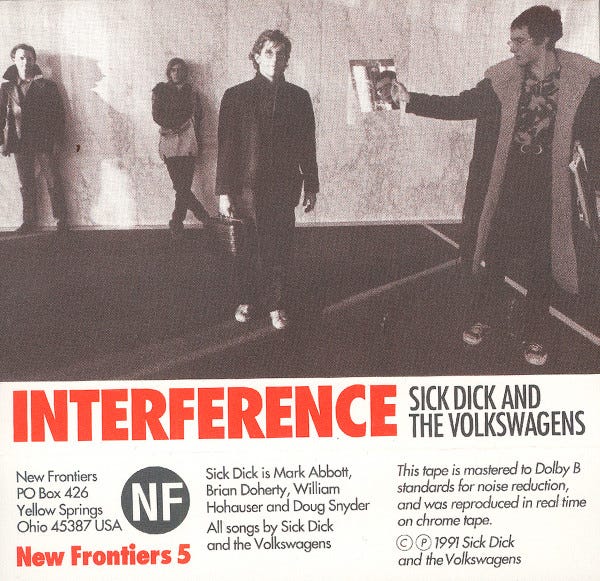
Sick Dick And The Volkwagens – Interference
A band that combines a Thomas Pynchon reference (hence their name dragged out of The Crying of Lot 49’s pages), Lower Manhattan No Wave skronk, members of Borbetomagus, with the only substantial information about the band coming from some long-forgotten independent website and a lonely Discogs user – I feel like every box that could be checked for me has been checked for me. I desire nothing more. This is what perfection, history-wise, would suggest. Musically, this is steeped in No Wave, with gnarled grooves, a drum machine in its death throes, and snarled vocals by someone (whose identity remains unclear) as the main features. Guitar riffs are present, but if you're expecting some punk niceties, well, this is much more evil-sounding, even apocalyptic. Yet, the late 1970s and early 1980s in NYC were apocalyptic, and it was a beautiful thing. Perhaps the world is on the verge of embracing this sense of creative destruction, an overthrow of old systems. Or possibly, the world will become some scrubbed clean, antiseptic version of itself, like Disneyland in Brooklyn named DUMBO (sorry DUMBO you deserved better). Either way, it will be interesting.
It becomes hard to avoid the political doomerism of Sick Dick And The Volkwagens because they are honestly on the creepy side of things. These are blown electronics and downright chaotic disorganizations. Whatever live shows they might have played, they must have smelled like stale beer, cigarettes, and extreme nihilism, the latter of which has a scent like the first two. Vocals are here, and they swim through the fuzz. Fidelity is non-existent; these takes were taken from a cassette player, and it shows. Yet, even in this disjointed state, you can still sense energy. Given how experimentally minded all the group members were, it is not surprising that they would create something as disorienting as this. This feels like waking up in the morning when you don’t want to and don’t have to, yet do it bleary-eyed out of a need for routine. When the saxophones enter the mix, the Borbetomagus comparisons become even more readily apparent. However, the playing is very much on the subdued side of things compared to the nuclear holocaust of Borbetomagus, who leave no prisoners behind and whose live concerts are things described through oral tradition alongside random online seedy music forums.
No Wave was, by default, an experimental sound, and they did perform at the usual No Wave venues, such as CBGBs, among others. Like other No Wave groups, they seemingly disbanded for no apparent reason, fading back into obscurity. Unlike many different genres, No Wave has an ego-death aspect behind it, where there are no heroes, no absolute legends, except perhaps for two to three people who have managed to stay alive into the present. Even by the No Wave standards, Sick Dick and Volkwagens had to wait even to get a crumb of interest, and that was almost a decade after they disbanded, only via cassette by New Frontiers in 1991. No agreement exists on who was a participant in the group, who even sang, and a handful of posters exist online, all of them looking about as grimy as one might expect from the music. Some influences are evident in the work – the fondness for Suicide’s hypnotic grooves is present, alongside the bare-bones mechanics that hold it together, such as the bass that seems to go on forever without any need to stop.
Even the title "Interference" is a reference to their first album, which itself became lost media. Initially, that was going to be released while they were still together, but nobody knows where it is. Perhaps Lester Bangs, a fan of the group. Maybe John Zorn (another fan) has it in a sock drawer, ready to unleash on the world. Whatever the case, the fact that we even have this is a miracle. It was issued once on cassette in 1991, accompanied by scant other information about the band. Indeed, the kind of group was designed for obscurity, but given the Pynchon reference that gave rise to them, that might have been a deliberate tactic on their part. Strangely meditative stuff, peculiar, and even, in the right mindset, soothing, though you’d have to be a bit of a freak to find this comforting.
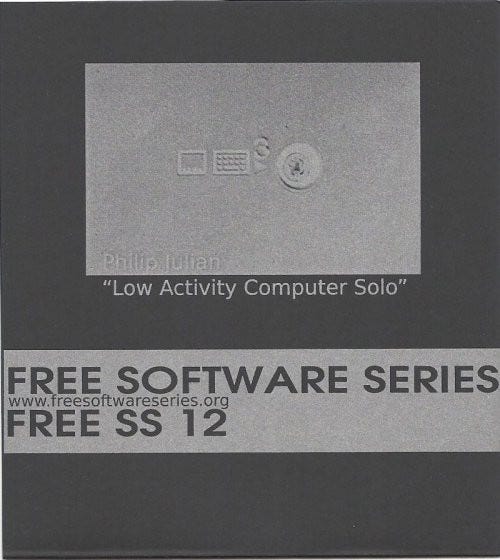
Philip Julian – Low Activity Computer Solo
Philip Julian’s computer certainly is low activity, but what do you expect from such a cheap machine? A little joke there for all the Philip Julian heads in the audience, but he has come a long way from his Cheapmachine days. This is minimalism for the ultra-minimal, though it is by no means quiet. One of the absolute pleasures to emerge from this short-duration album is the exploration of extremes, from quiet to almost noise. A confrontational listen; it is an anxious thing, and the computer is uncertain of itself; hence, there are sudden, abrupt outbursts. For me, this falls on the active side of listening, but composition-wise, it is not exceptionally high-energy. Instead, the silence here between movements adds to the discomfort. Moments of the work would be easily at home with Sachiko M’s or Otomo Yoshihide discography (perhaps the latter of which would be a tad more violent than this).
Before he had the confidence to release under his Christian name, he released under the highly satanic moniker Cheapmachines, a project that lasted for almost two decades. Why he changed his alias remains unclear; perhaps dozens of people worldwide were inspired by his work, and he wanted to start fresh in even greater anonymity. Whatever the reason, the short bursts of sound that he produces throughout the piece give it an evolutionary quality, as if he’s documenting a living, breathing organism. Fans of analog ways, of the outdated technology from previous generations that we have discarded, will find something of interest here. Melody and rhythm are accidental, and while he does stumble upon them, those moments are fleeting. Instead, like many experimental pieces, the purpose of this work appears to be to slow the listener down, encouraging them to engage with their surroundings. Given that Julian’s located in the UK, a notoriously loud, noisy, and deeply surveilled state, the idea might be to understand that the buzzing of these sounds is precisely what equipment makes as it documents the citizenry.
Released on the short-lived Free Software Series, a tiny label run by Mattin, it is a fascinating listen and an exploration of the failures of technology, of what computers could do when they want to have a lazy Sunday morning. This is what technology wants to do, like we want to – not to be overworked, underpaid, and exploited. In many ways, technology and humanity share a surprising number of similarities. Maybe that can be used for good or evil, but having the computer do some leisurely stretches is rather soothing. Computer music does not always need to be an intense experience; it can also be casual. I also appreciate, on a side note, the 200 limited runs of these CDRs, with 50 copies going towards the artist—a nice touch for the experimental art realm.
Questions, Comments, and Concerns:
Please email me at beachsloth32@gmail.com
Want to support me financially?
Please PayPal me at beachsloth32@gmail.com
**Your idea of a reasonable person, music-wise, I'm sure, differs from mine. **Still, if you’re already here, you’re already unreasonable by sheer virtue of your attendance, and I thank you for that. **
Last.fm
How much money would you say you spend on music? Most of these bands don't stream.