
12.28.2025

Good Morning,
This is Beach Sloth. Below are this week’s albums:
· Editor’s Note – Moving forward, anything that is abnormally loud and noisy beyond what a ‘reasonable person**’ would subject themselves to will be prefaced with a *Volume Warning*. Thank you.
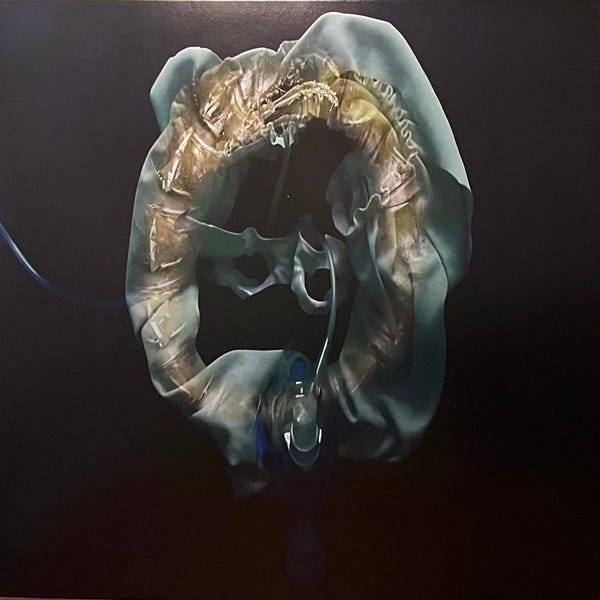
Ship Sket – InitiatriX
Dirty, grimy-ass sounds that haunt you at night, Ship Sket makes it weird on the dance floor with InitiatriX. Honestly, I have noticed the flirtation experimental music has been having with rave/EDM aesthetics for many years, and it finally sounds like the two are ready to consummate that marriage. Ship Sket strikes off the Planet Mu label, a label that has been shocking on top of things for a long time, thanks to Mike Paradinas. We got Venetian Snares and Luke Vibert off the guy, so thanks, balding bespectacled dude, you’re a real one. Sorry to hear about your divorce, but you appear to be doing better now.
Cut-up, staccato sounds dominate the world. Much of InitiatriX approximates what I had hoped Oneohtrix Point Never teased to deliver with Tranquilizer. Not that I hated that release, it left me cold. If you are going to invoke the holy name of Soulseek, you need to do it right. OPN did alright, but InitiatriX feels like what was promised, delivered by a younger, more hopeless-looking dude. Straight out of Dorchester, Ship Sket has a firm rooting within the club scene. To revisit the dude’s hopelessness, give him a hug or something; he’s clearly sad. I mean, I would be if I were living in present-day UK.
His mental state does not concern me. I like the mush he transforms out of the various samples and sentences. Poetry is here too, nicely dovetailing with another one of my interests. Bass hits with this ominous quality, going so deep. Sometimes it goes nearly dub-like, with the melody nicely infused into the bassline. I appreciate that, as dub is a powerful favorite of mine, and bass is generally an essential part of any mix for me. Out of left field comes some classical references, literature, and staccato blasts of spoken word. Classical tends to be one of those things dear to my heart, as I grew up with it. I also hate it when it is disrespected in sampling, so hearing it tastefully used is rare. Ship Sket does incorporate these moments quite well, also torturing the sounds to death until they become a cacophony. This is a visceral experience, and I cannot recommend good headphones enough to get the real experience.
I am strongly reminded of Andy Stott’s second wind, when he went into that slow as molasses 90 BPM as the beats tried to pull their feet out of the murk. Ship Sket has a similar spirit to me, taking all these genres, grime, jungle, EDM, boom-bap, and totally transforming them. The way that this comes together feels akin to Envane-Area Autechre, when they let their b-boy flag fly, as some of the best moments of the album come from this apocalyptic stance on hip-hop. While I have said this countless times, I will ask it yet again- are you okay, UK? You seem upset.
The fact that this is his debut album is mind-blowing. I imagine he has had a lot of experience figuring out what works and what does not work in front of crowds; that’s the only explanation I have, as it has this dialogue with the listener. Unsettlingly weird, creepy, skin-crawling, and representing a mutated form of genres left fermenting in toxic waste, it is a compelling, all-encompassing listen. I am very interested in what terrain he may explore next.
*Volume Warning*
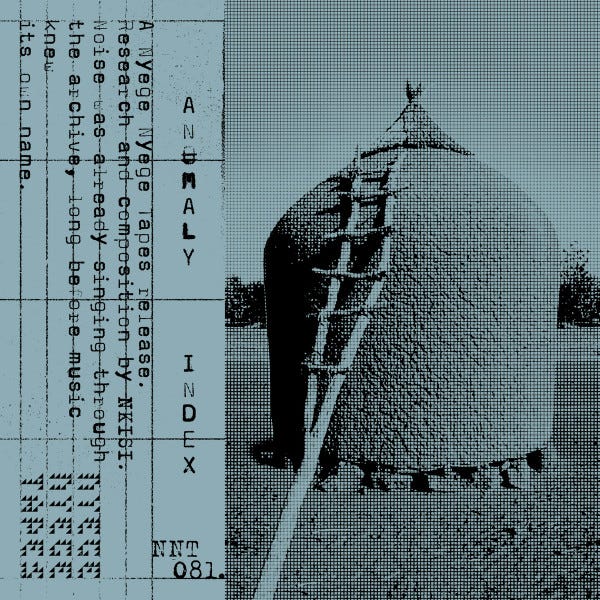
NKISI – Anomaly Index
Before noise music, there was the sound of malfunction. Improperly played instruments, a note missed, a beat skipped, the ever-so-slightly off aspect. We have had these errors for thousands of years, the aural failures of the world. I personally love them, and my first bloom, where I’d eventually travel down in an audio way, came through the glitch movement of the 90s and early 2000s. Now that glitch effect is so heavily ingrained within pop music that it is impossible to separate it from it. Think of trap music, same thing, the beat came from a failure, yet it remains insanely catchy. To this effect, NKISI shows that the concepts of glitch and lo-fi splendor emerged well over a century ago, when we were trying to capture sounds worldwide.
NKISI has explored this territory before, earning her the enviable title of sonic archaeologist. Her previous works incorporated elements of the ancient within a modern context. With the Anomaly Index, the error is the point. Biennale Musica 2025 in Venice was the debut of the work, and her releasing it on tape makes sense, as there is an ancient quality to the way she approaches the sound. Additionally, the tape’s degradation could be another part of the process. She goes very far down the line with this one – you thought the Caretaker dealt with degradation? None of these recordings is after 1910, making all the phonograph samples well over 100 years old. The age is an aspect of the sound and the fidelity, showing what we used to listen to and how accepting we were of errors in the source code. Now we need everything crystal clear, clean-sounding, flawless. Everybody is a Steely Dan fanatic, wanting the cleanest possible sound. While lo-fi has made some strides, in comparison to the much larger picture, it is but a tiny percentage of the overall listening diet.
The geography of the samples, ranging from Cameroon to Papua New Guinea, the latter of which remains so far off the beaten path that it takes a day or longer to reach, and is one of the largest concentrations of languages in the world. NKISI does excellent work in teasing the grooves out of these two very extended pieces, both of which reach the twenty-minute mark. Are either of them straightforward? Will you be humming any of this? Honestly, you possibly could. Occasionally, the sheer repetition and distorted audio effects make it feel like a transmission from another planet, which it is in a specific way. Nobody from the early 1900s is alive now, though they were awfully kind to leave these transmissions behind for someone in the future to manipulate.
For the longest time, music was built around the idea of a build-up, of processes functioning normally. We had these imperfections, of industrial clang, of noise music, of lo-fi, of William Basinski’s sadistic tape loops, the Caretaker’s desire to capture the sound of dementia, of losing memory, but they were in the margins. Perhaps they will remain that way. I doubt anything with tearing down sound will ever be wildly popular. Yet, as we’ve seen before, those errors, the improvised, the broken, do find a way into mainstream culture. Nyege Nyege Tapes did a fantastic job in putting out this surprisingly trance-like statement on cassette, which feels even more perfect. A completely overwhelming approach to sound design that shows the history and the chaos of trying to recover that history. Maybe this is the best we can do: celebrate imperfections rather than edit them out?
*Volume Warning*
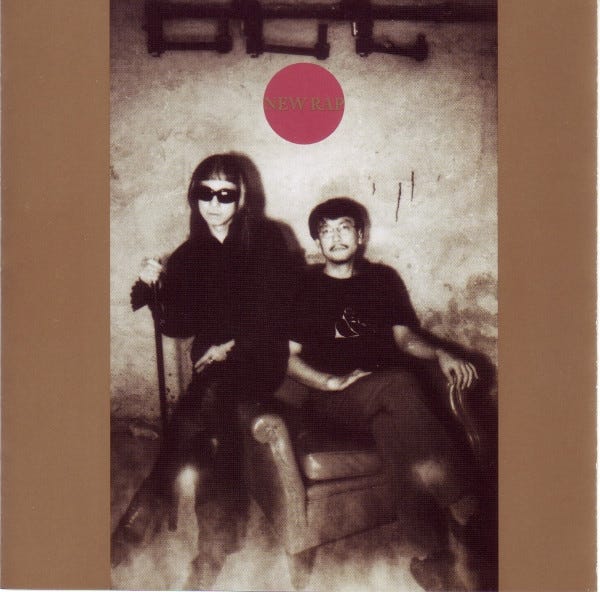
Keiji Haino & Tatsuya Yoshida – New Rap
Every single track is named after a specific part of New York City, and the music is a chaotic, cacophonous din. Yes, obviously John Zorn is involved, if only through releasing this beast on his Tzadik label. I highly recommend playing this at an unreasonable volume. You want the full-fledged live physicality that Keiji Haino & Tatsuya Yoshida were going for. John Zorn also does the producing on here, and the result is a thing of pure affection.
Keiji Haino & Tatsuya Yoshida are a perfect pair. All the vocalizations —screams, grunts, snarls, and whatever other animal noises he can conjure up —Keiji does well. He’s on the guitar, and the guitar veers wildly between no wave noise, disjointedness, and genuinely catchy moments. Tatsuya Yoshida is an exceptional drummer, offering elements of form at times, sometimes just embracing further dissonance. If you can nod your head to any of this, you may be having a seizure and should immediately seek medical attention.
I like the interplay between the pair. The song titles also make sense, and, from a nostalgic viewpoint, I love them. Every place is captured effectively and thoroughly through the wild gesticulations. Manhattan is the only borough referenced here – no Brooklyn, no Bronx, no Queens. Staten Island was never running. Who would pick that sad, sorry, smelly state, a borough so rotten even New Jersey voted no thanks? Anyway, I think the energy they bring to each section of the Dutch-purchased island feels appropriate. Dirty, grimy stuff, this is the city I grew up in before all the homeless people just disappeared. Where did they go? I don’t know, but it is weird because there were so many more homeless people when I was growing up, and the city did not get any cheaper since my childhood, quite the opposite in fact.
For all the broken beats and bits, something is compelling about their approach. Think of it as a duo trying to approximate the energy of the Boredoms, and succeeding to a large degree. Aspects of it fall accidentally into some colossal jams, whether it is a tribal fervor or something akin to a Don Caballero track, because Tatsuya is that good of a drummer. Other moments touch upon the no-wave orchestral bliss of Glenn Branca’s early ‘80s madness. I appreciate all aspects of the album, from the howling vocals to the sheer brutality of some of their attacks. Some of the mellower moments, besides serving as a delicate palate cleanser, also reveal that the two of them have a real talent for form and the proper amount of restraint when needed.
Released in the excellent year of 2006, which was a productive year for me, it reminds me of the unhinged nature of many things happening in music around that time. My only regret from 2006 remains not buying that property in Red Hook, but beyond that, I nailed that year. This reflects upon the strange optimism of the era, when noise finally mellowed and started having fun, incorporating new genres into its surprisingly conservative outlook. If you remember the thrill of early Black Dice before they fully embraced dance, or of the broken nature of so much of the grimy dance punk like Les Georges Leningrad, Aids Wolf, then this is something that may be of interest to you. You may not be able to dance to all of it, but you are certainly welcome to try.

Sheriff Lindo And The Hammer - Ten Dubs That Shook The World
Sheriff Lindo and The Hammer demand a fine sound system for the sheer weight of ‘Ten Dubs That Shook The World.’ For those who are thinking of playing this on tinny speakers, no, don’t, you’re so sexy aha. The appeal of this comes from the sheer, undeniable heaviness. When I first put this on, I was going to make it a more casual listen. After about six seconds, I realized that was the wrong call and immediately got out the speakers. Anybody reading this, if you’d like to contribute to an even stronger sound system besides what I have now, feel free to do so. I live in Sound.
These dubs originate from Australia, which genuinely surprised me. I think Australia and New Zealand generally reside on a different timeline from the rest of the world. Unlike the rest of the world, in Australia and New Zealand’s timeline, Weezer released their first album, the Blue Album, and then mysteriously all died in a tragic plane crash. Post-punk lives there still and has exported some great sounds to me. A band called Tropical Fuck Storm can flourish there. The “C Slur” is alive and well in that neck of the woods. Every single plant and animal in the area is designed to kill you. You touch a beautiful flower down there, you die, and the poison causes you to turn inside out. Birds firebomb forests. That’s the nature down there – brutal, so the people must be a tad strange to want to continue living there.
Whatever good thing you remember from a few years ago is now becoming popular down in that corner of the universe. Roy Montgomery, an exceptional guitarist, would have starved in any other place, yet he has managed to scrape together a career. Most of the world would’ve relegated Roy Montgomery to being some studio session man, eating dumpster bagels, and living in squats. Just look at how Loren Connors survived in New York City versus how he might have gotten actual respect with his ambient guitar noodling and cosmic trips over in that corner. I am glad they do things slowly there; I am a sloth, after all, so I generally dislike the fast pace of modernity. I want to hang upside down in a tree and spend most of my life sleeping.
So, the fact that these dubs came out in 1988, well after the initial wave of dub’s late 1970s/early 1980s popularity, makes sense. These took time, and that shows. Anthony Maher recorded these over the course of seven years, from 1981 until 1988, when they were the inaugural release for the Endless Recordings label. Gigantic does not do these grooves justice. I like them so much because there are aspects of the atmosphere that typically don’t appeal to me. For example, a few of the tracks feature synthesizers, which I generally have mixed feelings about. Yet, for the overall mood, I think they work well in this context. Maher has an inherent darkness about the approach, and it shows – quite literally in the song titles, but also in the atmosphere. It is cavernous, and while that’s dub’s general modus operandi, it is doubly true here. While driving through my area, watching the leaf death and seeing all the leaf corpses on the ground, it let me know it was autumn, tapping into the spooky season spirit for me without unnecessary wordiness.
The tracks have this narcoleptic catchiness, the way good dub typically has. While listening to this, you get a sense of how much dub has contributed to music, serving as a silent partner for genres like post-punk, dub techno, dubstep, and trap. I hear traces of what would eventually become The Bug, the eerie hues of Burial’s approach. Just because not everything dub-related has this same level of taste does not mean that it is simply okay to ignore. As a largely wordless genre, it may not necessarily appeal to people who require lyrics to be included in their music. I prefer instrumentals generally (always have), and a handful of these tracks would not work with vocals. Eastern Bloc, probably my personal favorite, works because the bass weighs a ton, and the sound almost descends into post-industrial territory, conjuring up imagery of abandoned factory floors and decaying, wrecked economies. Given that this was released only a few years before the fall of the Berlin Wall, it has a strange prophetic quality, foreshadowing how the darker side of 90s music would unfold.
Age has helped this LP enormously. It has aged very gracefully. Original copies of the vinyl now go for a few hundred, and, given how darkly lovely the whole thing is, it makes sense. This is far from cheery work, but there is something so trance-inducing about the execution that is impossible to deny.
Questions, Comments, and Concerns:
Please email me at beachsloth32@gmail.com
Want to support me financially?
Please PayPal me at beachsloth32@gmail.com
Throne
Throne | Beach Sloth | My Wishlist
**Your idea of a reasonable person, music-wise, I’m sure, differs from mine. **Still, if you’re already here, you’re already unreasonable by sheer virtue of your attendance, and I thank you for that. **
Last.fm
Beach Sloth is a Moral Center. Reviews of Albums that are outside the scope of Popular Cultural Outlets.
Occasionally a welcomed review of a Book of poetry. Lyrics might even be a term that applies here.
Beach Sloth could write anything. But that isn't the case.
If one persists in ethical behavior long enough, their actions become a Moral Compass...
I love that Sheriff Lindo joint, gonna lay around & look up a the other recs tonight…